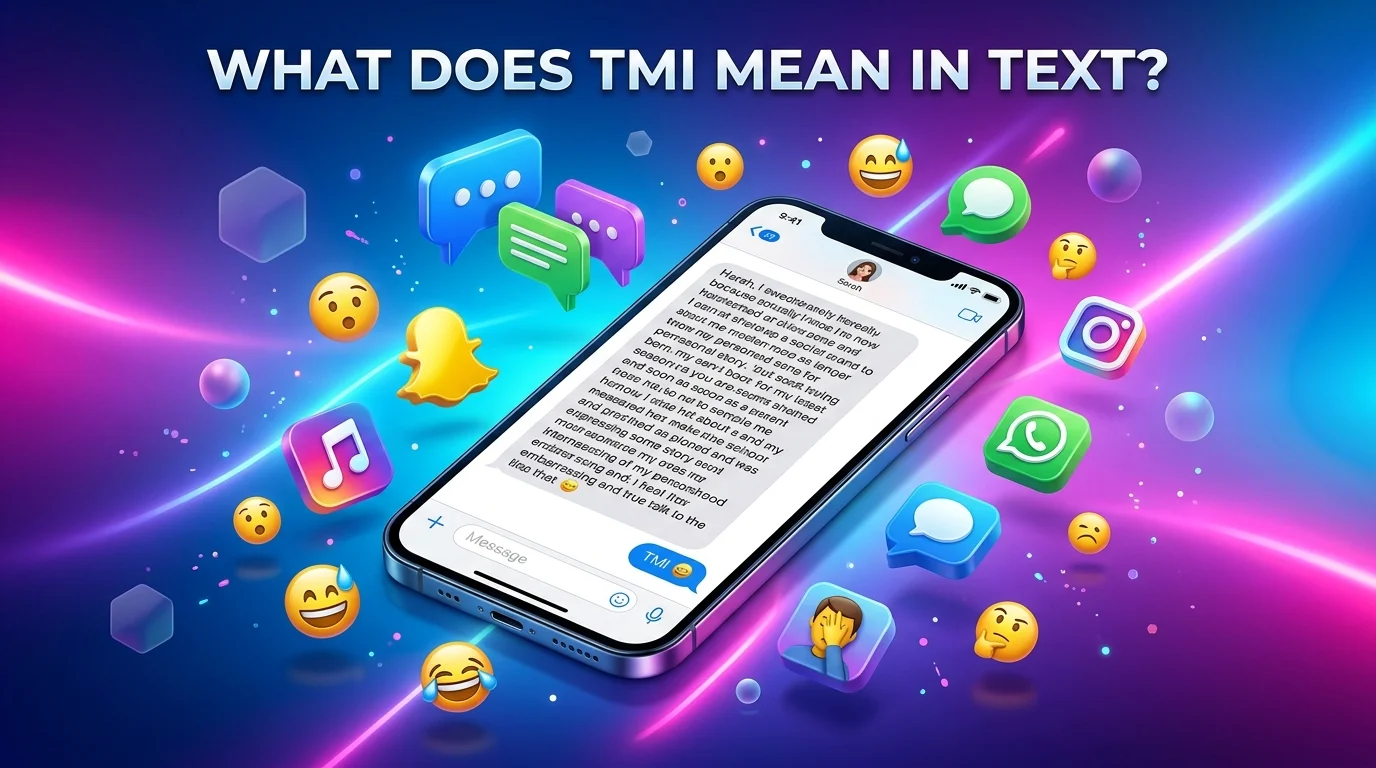

Have you ever been chatting with a friend, scrolling through social media, or reading a group conversation when someone suddenly replied with TMI? If so, you may have paused and wondered what does TMI mean in text and why people use it so often. Internet slang has become a huge part of online communication, and abbreviations like TMI help people express reactions quickly without typing long sentences.
Unlike some texting acronyms that have several meanings, TMI has one primary definition, but the way people use it can change depending on the situation, the relationship between the people chatting, and the tone of the conversation. Sometimes it is used as a joke between close friends, while other times it politely tells someone they have shared more personal information than necessary.
Understanding what does TMI mean in text can help you avoid awkward misunderstandings and know when it’s appropriate to use the phrase yourself. Whether you’re chatting on WhatsApp, Snapchat, TikTok, Instagram, Discord, or regular SMS, knowing the meaning of TMI will make online conversations much easier to understand.
In this complete guide, you’ll learn exactly what TMI means, where it came from, how it became popular, how people use it across different social media platforms, and see plenty of real-life texting examples that explain every situation.
Quick Answer: What Does TMI Mean in Text?
TMI stands for Too Much Information.
People use TMI when someone shares personal, embarrassing, unnecessary, or overly detailed information that others did not need to know. Depending on the conversation, TMI can be funny, playful, polite, or slightly uncomfortable.
Quick Examples
- TMI… I didn’t need to know that.
- Haha, that’s definitely TMI.
- Thanks for sharing, but TMI.
- Okay, that’s a little TMI.
In most text conversations, TMI is not meant to be rude. Instead, it gently lets someone know they may have shared more details than necessary.
Where Did TMI Come From?
Although TMI feels like modern internet slang, the phrase Too Much Information existed long before texting and social media became popular.
People have used the expression Too Much Information in everyday conversations for decades whenever someone shared details that were considered too personal, embarrassing, or unnecessary. During the 1980s and 1990s, the phrase became increasingly common in television shows, comedy, magazines, and everyday speech. As internet chat rooms, online forums, and instant messaging services became popular in the late 1990s and early 2000s, people shortened the phrase to TMI to save time while typing.
The abbreviation quickly spread across text messaging, MSN Messenger, AOL Instant Messenger, Facebook, Twitter, and eventually Snapchat, TikTok, Instagram, and WhatsApp. Today, millions of people use TMI every day as a quick reaction whenever someone overshares information.
Unlike many slang terms that fade over time, TMI has remained popular because almost everyone has experienced conversations where someone accidentally reveals more than others wanted to hear.
What Does TMI Mean in Text?
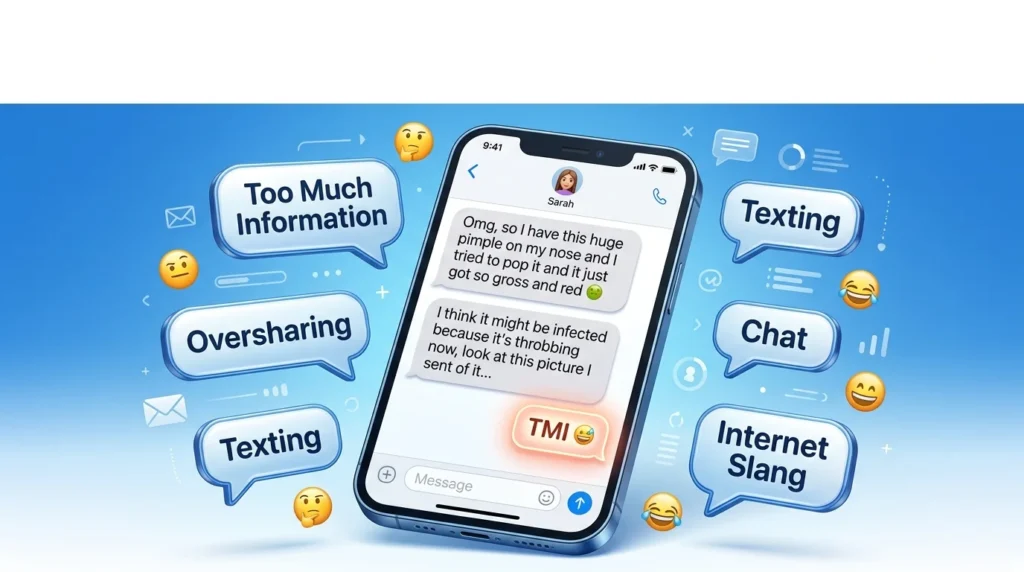
The meaning of TMI in text is simple but highly dependent on context. At its core, TMI means that someone has shared more information than the listener expected or wanted to know. The information could be personal, embarrassing, overly descriptive, or simply unrelated to the conversation.
For example, if someone starts describing a medical problem in great detail during a casual chat, another person might reply with TMI. Similarly, if a friend shares intimate relationship details in a group chat, someone may jokingly respond with TMI to signal that the conversation has become too personal.
However, TMI is not always negative. Close friends often use it playfully when joking about funny or awkward situations. In many cases, replying with TMI actually keeps the conversation lighthearted instead of making someone feel embarrassed.
Because texting lacks facial expressions and body language, people often add laughing emojis or smiling emojis after TMI to show they’re joking rather than criticizing the other person.
Understanding the tone behind the message is just as important as understanding the words themselves.
Different Contexts of TMI in Text
TMI as a Funny Reaction
One of the most common ways people use TMI is as a humorous response after someone accidentally overshares. Friends often tell funny stories involving embarrassing moments, strange habits, or awkward experiences. Rather than becoming uncomfortable, someone simply replies with TMI to laugh about the situation. This creates a relaxed atmosphere where everyone understands the comment is playful instead of insulting. For example, if someone starts describing a weird dream or an embarrassing bathroom story, friends might quickly respond with TMI followed by laughing emojis. In these situations, TMI actually adds humor to the conversation and helps everyone enjoy the joke without taking the story too seriously.
TMI as a Polite Way to Set Boundaries
Sometimes people use TMI because they genuinely feel that a conversation has become too personal. Instead of directly telling someone to stop talking, replying with TMI is often a softer and more polite way to express discomfort. It lets the other person know they may have crossed a personal boundary without creating unnecessary conflict. This usage commonly appears in workplace chats, casual friendships, or online communities where people may not know each other very well. By saying TMI, the listener communicates that certain details are better kept private while still maintaining a respectful and friendly conversation.
TMI as Friendly Teasing
Among close friends, TMI often becomes part of playful teasing rather than serious criticism. Friends know each other’s personalities and understand when someone likes telling long stories or sharing dramatic experiences. In these conversations, replying with TMI is usually accompanied by jokes, memes, or laughing emojis. The goal isn’t to embarrass anyone but to keep the conversation entertaining. Since everyone understands the friendship dynamic, nobody takes offense. This version of TMI actually strengthens conversations because it creates humor while reminding everyone not to overthink awkward moments.
TMI as a Sign Someone Shared Too Many Details
Not every use of TMI is humorous. Sometimes people genuinely feel overwhelmed by the amount of information someone shares. This often happens when conversations suddenly include detailed medical issues, relationship problems, family drama, or private experiences that others were not expecting. Instead of ignoring the message or changing the topic, someone may simply reply with TMI. Although it can sound slightly blunt depending on the wording, it generally serves as a gentle reminder that not every detail needs to be shared in every conversation. The effectiveness of this response depends heavily on the relationship between the people involved.
Tone Variations of TMI in Text
Playful Tone
The most common tone for TMI is playful. Friends regularly use it after hearing funny stories that include slightly embarrassing details. Instead of criticizing the storyteller, they respond with TMI to show they’re laughing at the situation. This tone often includes emojis, GIFs, or reactions that make it obvious everyone is joking. Because the atmosphere remains relaxed, nobody feels insulted. In fact, playful TMI has become a common part of internet humor and group chats where friends enjoy teasing one another in a lighthearted way.
Sarcastic Tone
Sometimes TMI carries a sarcastic tone, especially when someone repeatedly shares unnecessary details. In these situations, the response may suggest mild frustration while still avoiding direct confrontation. For example, if a coworker constantly talks about personal issues during unrelated conversations, another person might reply with TMI to hint that the discussion has gone too far. While sarcasm can make the message stronger, the relationship between the people involved usually determines whether it feels funny or offensive. Because tone is difficult to judge through text alone, people often soften sarcastic TMI with emojis.
Serious Tone
Although less common, TMI can also be used seriously when someone shares information that makes others uncomfortable. This may happen during discussions involving graphic injuries, private health conditions, or deeply personal relationship problems. In these cases, replying with TMI is not intended as humor. Instead, it politely communicates that the conversation has entered territory that others would rather avoid. Even when used seriously, TMI usually remains less confrontational than directly asking someone to stop talking.
What Does TMI Mean on Snapchat?
On Snapchat, TMI usually appears in private chats, streak conversations, and replies to stories. Since Snapchat encourages spontaneous and casual communication, users often share random moments from their daily lives. Occasionally, someone may post or send something that reveals more personal information than their friends expected. When this happens, the reply TMI is often used as a playful reaction rather than criticism.
For example, if someone sends a Snap describing an embarrassing situation in great detail, friends may respond with TMI followed by laughing emojis. This lets the sender know they probably shared more than necessary while keeping the conversation fun. In close friendships, TMI often becomes an inside joke because everyone understands the relaxed nature of Snapchat conversations.
Because Snapchat messages disappear, people sometimes feel more comfortable sharing personal stories. Even so, TMI serves as a friendly reminder that some details might be better left unsaid. Most Snapchat users interpret the abbreviation as humorous instead of rude.
See Also: What Does OG Mean in Text? Real Meaning Explained + Examples
What Does TMI Mean on TikTok?
On TikTok, TMI commonly appears in comments, captions, and reply videos whenever creators reveal overly personal stories or embarrassing experiences. Since storytelling is one of TikTok’s most popular content formats, creators often share funny, awkward, or emotional moments from their lives. Viewers who feel a story includes unnecessary details may simply comment TMI.
However, many TikTok users intentionally create TMI-style videos because oversharing has become part of internet entertainment. In these cases, comments saying TMI are often compliments acknowledging that the creator was brave enough to share something personal. Some creators even use hashtags related to TMI when posting funny confessions or awkward life experiences.
Overall, TMI on TikTok usually reflects humor, surprise, or mild embarrassment rather than criticism. The context of the video and the relationship between creators and followers determines whether the phrase feels playful or serious.
What Does TMI Mean on Instagram?
Instagram users frequently use TMI in comments, direct messages, stories, and reels whenever someone shares more personal information than expected. Since Instagram combines lifestyle content, personal updates, and entertainment, the abbreviation naturally appears across many different types of conversations.
For example, someone might post a long story describing an embarrassing medical appointment or an awkward dating experience. Friends may reply with TMI as a humorous way of saying they didn’t need every detail. Likewise, creators who share honest daily experiences often receive playful comments saying TMI from followers who enjoy their openness.
In private Instagram messages, TMI can also help set friendly boundaries if a conversation becomes too personal. Instead of sounding harsh, the abbreviation keeps the tone casual while gently suggesting that certain details may be unnecessary. Across Instagram, TMI is generally understood as lighthearted internet slang rather than an insult.
What Does TMI Mean on WhatsApp and in General Texting?
On WhatsApp and regular text messages, TMI is commonly used when someone shares information that feels too personal, too detailed, or simply unnecessary for the conversation. Since WhatsApp is often used for chatting with close friends, family members, classmates, and coworkers, the phrase can take on different meanings depending on who you’re talking to.
For example, if a friend starts describing an embarrassing doctor’s appointment in great detail, another friend might reply with TMI followed by a laughing emoji. In this situation, the response is meant as a joke rather than criticism. However, if someone shares very private relationship problems in a group chat, another person may use TMI more seriously to suggest that the conversation has become uncomfortable.
In everyday texting, TMI usually acts as a gentle social cue instead of a rude comment. It reminds the speaker that not every detail needs to be shared while keeping the conversation friendly. Because tone can sometimes be misunderstood in text messages, many people pair TMI with emojis like 😂, 😅, or 🤣 to make it clear they’re teasing rather than judging.
Real-Life Texting Examples of TMI
Casual Example
Friend: I accidentally wore two different shoes to school today.
You: Haha, that’s funny.
Friend: Then I didn’t notice until lunch.
You: TMI… but that’s hilarious.
Funny Example
Friend: I talked to my cat for thirty minutes this morning.
You: TMI 😂
Embarrassing Example
Friend: I slipped in the bathroom again today.
You: Okay… TMI 😅
Relationship Example
Friend: We argued for three hours and then cried together.
You: That’s a little TMI.
Medical Example
Friend: Let me tell you every detail about my dentist appointment.
You: TMI, please spare me the details.
Group Chat Example
Friend: I still sleep with my childhood teddy bear.
Everyone: TMI 😂
Family Example
Sibling: Dad snores louder than a train every night.
You: TMI, but I believe it.
School Example
Friend: I forgot to wear deodorant today.
You: That’s definitely TMI.
Workplace Example
Coworker: I think I ate something bad and spent all morning…
You: TMI 😅
Social Media Example
Comment: Nobody asked for that much information.
Reply: TMI.
Friendly Teasing Example
Friend: I still have every birthday card I’ve ever received.
You: You’re giving us TMI today.
Gaming Example
Friend: I stayed awake for twenty hours playing that game.
You: That’s impressive… and also TMI.
Awkward Example
Friend: Let me explain every detail of my breakup.
You: Maybe that’s a little TMI for the group chat.
Serious Example
Friend: I shouldn’t have shared all that.
You: It’s okay. I was just joking when I said TMI.
Other Meanings of TMI
Although What Does TMI Mean in Text almost always refers to Too Much Information, the abbreviation can occasionally have other meanings depending on the topic or industry. These alternative meanings are much less common than the internet slang version.
Too Much Information
This is by far the most popular meaning and the one almost everyone recognizes in texting, social media, and online conversations.
Three Mile Island
In history and news discussions, TMI may refer to the Three Mile Island nuclear power plant in Pennsylvania. This meaning is rarely seen in casual texting because the context usually makes it obvious.
Technical or Business Terms
Some companies, organizations, and industries use TMI as an abbreviation for internal projects, products, or business names. These meanings are highly specialized and are not commonly used in everyday conversations.
For the average internet user, TMI almost always means Too Much Information.
See Also: What Does OAT Mean in Text? Full Meaning, Uses & Examples Explained
Slang Similar to TMI
| Slang | Meaning | Common Usage | Tone |
|---|---|---|---|
| TMI | Too Much Information | Oversharing in chats | Funny or Polite |
| FYI | For Your Information | Sharing useful information | Neutral |
| IDC | I Don’t Care | Showing disinterest | Casual |
| TBH | To Be Honest | Giving honest opinions | Honest |
| SMH | Shaking My Head | Disappointment or disbelief | Frustrated |
| LOL | Laughing Out Loud | Funny conversations | Humorous |
| BRB | Be Right Back | Temporary absence | Casual |
| OMG | Oh My God | Surprise or excitement | Emotional |
What Does TMI Mean From a Girl?
When a girl uses TMI in a text, it is usually meant to be playful, friendly, or gently honest. If she replies with TMI after hearing a funny or embarrassing story, she is often teasing rather than criticizing. Among close friends, girls commonly use the abbreviation to laugh about awkward situations without making the conversation feel uncomfortable.
For example, if someone starts talking about an embarrassing date or shares too many personal details, she may simply reply with TMI and a laughing emoji. This response suggests that the story became more detailed than expected while still keeping the mood light.
In some situations, a girl may use TMI more seriously if a conversation becomes overly personal or emotionally overwhelming. Even then, the phrase usually acts as a polite boundary instead of a harsh rejection. Understanding her tone and the overall conversation is important before assuming she is upset.
What Does TMI Mean From a Guy?
When a guy uses TMI in texting, the meaning is generally straightforward. He usually wants to say that someone has shared more information than necessary. Depending on the friendship, the abbreviation may sound humorous, sarcastic, or genuinely uncomfortable.
Among male friends, TMI often appears after funny or embarrassing stories. For instance, if someone describes an awkward gym experience or a strange medical problem, another friend might reply with TMI followed by laughing emojis. The goal is usually to joke around rather than offend anyone.
However, if the topic becomes extremely personal, a guy may use TMI to signal that the conversation has crossed his comfort level. In these cases, the phrase acts as a subtle way to change the subject without directly telling someone to stop talking. As with any slang, context and relationship determine the true meaning.
When Should You Use TMI?
TMI works best in casual conversations where everyone understands internet slang and shares a relaxed relationship.
You can use TMI when:
- Someone tells an overly detailed story.
- A friend shares an embarrassing moment.
- You’re joking with close friends.
- Someone overshares in a group chat.
- You want to politely suggest that certain details were unnecessary.
- The conversation remains lighthearted.
- Everyone understands the joke.
When used appropriately, TMI keeps conversations fun without sounding overly harsh.
When Should You Avoid Using TMI?
Although TMI is popular online, it is not suitable for every situation.
Avoid using TMI when:
- Someone is discussing a serious health issue.
- A person is sharing emotional trauma.
- You’re speaking with your boss or clients.
- You’re writing professional emails.
- Someone genuinely needs emotional support.
- The other person may not understand internet slang.
- The conversation requires empathy rather than humor.
Showing sensitivity is more important than using slang in serious conversations.
Common Mistakes People Make About TMI
Many people misunderstand how TMI should be used. Here are the most common mistakes.
Thinking TMI Is Always Rude
Most of the time, TMI is playful and humorous rather than insulting.
Using TMI in Serious Conversations
If someone is sharing difficult personal experiences, replying with TMI may seem insensitive.
Assuming TMI Only Refers to Embarrassing Topics
People can say TMI about any unnecessary detail, not just embarrassing stories.
Forgetting That Tone Matters
The same abbreviation can sound funny, sarcastic, or rude depending on the wording, emojis, and relationship between the people chatting.
Frequently Asked Questions
What does TMI mean in text?
TMI stands for Too Much Information. It is used when someone shares more personal or unnecessary information than expected.
Is TMI rude?
Not usually. TMI is generally used as a playful or polite response among friends. However, tone and context matter.
What does TMI mean on Snapchat?
On Snapchat, TMI usually reacts to funny or overly personal snaps and messages. It is often meant as a joke.
What does TMI mean on TikTok?
On TikTok, TMI commonly appears in comments about creators who share embarrassing, funny, or deeply personal stories.
Can TMI be a compliment?
Generally, no. TMI is not a compliment. It simply points out that someone shared more information than necessary, although it is often said in a humorous way.
Is TMI still popular?
Yes. TMI remains one of the most widely recognized internet slang terms across WhatsApp, Instagram, TikTok, Snapchat, Discord, and regular text messaging.
Should I use TMI in professional conversations?
No. It is better to avoid internet slang like TMI in formal emails, workplace communication, or professional settings unless you know the other person is comfortable with casual language.
Conclusion
Now that you understand What Does TMI Mean in Text, you’ll recognize why this abbreviation has remained popular for so many years. While TMI simply stands for Too Much Information, its meaning depends on the conversation, the relationship between the people involved, and the tone of the message. Most of the time, it is used as a lighthearted way to react when someone shares more details than necessary.
Whether you see TMI in a WhatsApp chat, a Snapchat reply, an Instagram comment, or a TikTok discussion, it usually serves as a playful reminder that a story has become a little too detailed. In serious situations, it can also help set polite boundaries without creating unnecessary conflict.
The next time someone texts TMI, you’ll know they’re usually reacting to oversharing rather than trying to be rude. And now that you understand when and how to use it, you can confidently include this popular piece of internet slang in your own conversations while avoiding awkward misunderstandings.
See Also: What Does IGHT Mean in Text? Real Meaning Explained