


Have you ever stopped while writing and wondered whether you should use historic or historical? Many English speakers use these words interchangeably, but they do not mean exactly the same thing. Understanding the difference between historic vs historical can instantly improve your writing, communication, and confidence in English.
Although both words relate to history, they serve different purposes. One describes something important enough to be remembered, while the other simply refers to anything connected to the past. This small distinction creates a big difference in meaning.
Whether you’re a student, writer, professional, or simply curious about English vocabulary, this guide will help you understand when to use each term correctly. You’ll learn definitions, origins, examples, social media meanings, common misconceptions, and practical usage tips that make the difference easy to remember.
Meaning & Definition
The topic historic vs historical refers to the difference between two closely related English adjectives that are connected to history.
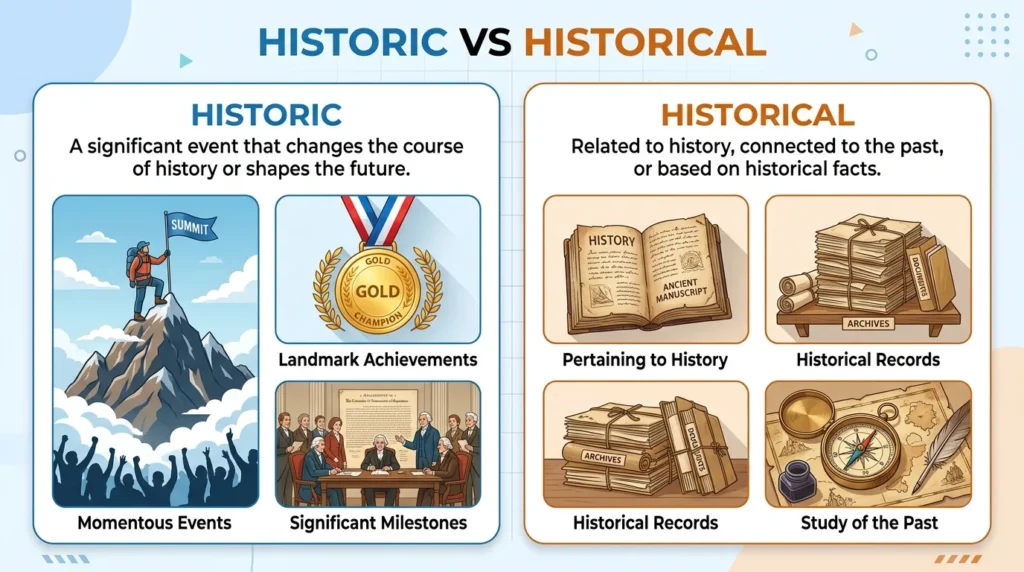
Historic means something that is important, significant, memorable, or likely to be remembered in history.
Historical means something related to history, the past, or historical records, regardless of importance.
The most common distinction is simple:
- Historic = important in history
- Historical = related to history
For example, a peace treaty that changes a nation’s future is a historic event, while a book about ancient Rome is a historical book.
Remembering this basic rule will help you use both words correctly in everyday conversations and formal writing.
What Does Historic vs Historical Mean?
Historic vs historical refers to the difference between two words associated with history. A historic event is important enough to be remembered and recorded because of its impact. A historical event, object, person, or document is simply connected to the past or history.
Quick Rule:
- Historic = significant in history
- Historical = related to history
Example:
- The moon landing was a historic achievement.
- Researchers studied historical records of the moon mission.
Background / Origin
The confusion between historic and historical has existed for centuries because both words come from the same root: the word history. Their origins can be traced back to Greek and Latin languages before entering English through Old French influences.
The word historic appeared in English around the 17th century. It was primarily used to describe events, places, or achievements that held great importance and deserved a place in history. Over time, it became associated with major milestones, groundbreaking discoveries, and unforgettable moments that shaped societies.
The word historical emerged around the same period but developed a broader meaning. Instead of emphasizing importance, it referred to anything connected with history or the study of the past. Historical documents, historical novels, and historical research are examples of this wider usage.
Modern English maintains this distinction because it helps communicate whether something is merely related to history or genuinely significant within it. While some people still use the terms interchangeably in casual conversation, professional writers, journalists, historians, and educators typically follow the traditional difference.
Understanding the origin of these words makes it easier to remember their modern meanings. Both belong to the same linguistic family, but each evolved to perform a different role in communication.
Usage in Different Contexts
General Usage

In everyday English, people often confuse historic and historical because both words relate to the past. However, choosing the correct term makes your message more accurate and professional. When describing a major event that changed history, use historic. When discussing facts, records, buildings, books, or information connected to the past, use historical.
For example, a journalist might describe a groundbreaking election result as a historic victory because it marks an important milestone. On the other hand, a museum may display historical artifacts because they come from the past, regardless of whether each artifact changed history. The distinction becomes especially useful in academic writing, news reports, educational content, and public speeches. Understanding this difference helps avoid common grammar mistakes and improves clarity. Native speakers often appreciate precise language, and using these words correctly shows strong communication skills.
Formal Usage
In formal writing, the difference between historic and historical becomes more important. Academic papers, news articles, government reports, and professional publications usually follow the traditional distinction. Historians may write about historical evidence, historical sources, and historical research because these materials are related to history. However, they might describe a revolutionary event as a historic moment because it had a major impact on society.
Formal communication values precision. Using historic when referring to significance and historical when referring to connection helps readers immediately understand the intended meaning. Many style guides, editors, and educational institutions encourage this distinction because it improves clarity and professionalism. If you’re writing for school, business, publishing, or journalism, following the correct usage is highly recommended.
Informal Usage
In casual conversations, social media posts, and everyday communication, many people use historic and historical interchangeably. Most listeners still understand the intended meaning from context. For example, someone might say, “We visited a historic museum,” even though “historical museum” may technically fit better depending on the context.
Despite this flexibility, using the correct word can make your communication sound more polished. Social media users, bloggers, and content creators often prefer simpler language, so strict grammar rules are not always followed. However, understanding the distinction remains valuable because it allows you to communicate more accurately when needed. Even in informal settings, correctly using historic and historical can improve credibility and demonstrate strong language skills.
Historic vs Historical Meaning on Social Media Platforms
Although these words are mainly grammar-related terms, they occasionally appear on social media in different contexts.
- WhatsApp → People may use “historic” to describe an important personal achievement, such as graduation, marriage, or a major life event. “Historical” is usually used when sharing facts, documentaries, or information about the past.
- Snapchat → Users sometimes call a memorable moment a “historic snap” as a humorous exaggeration. Historical content may include old photos, throwback memories, or past events.
- TikTok → Creators frequently use “historic” for viral moments, major announcements, or trending events. Historical content often includes educational videos about ancient civilizations, wars, and famous figures.
- Instagram → Historic is commonly used in captions celebrating achievements, milestones, and memorable experiences. Historical is often used for educational posts, travel content featuring old landmarks, and history-focused pages.
Other Meanings in Different Fields
While the words generally maintain the same definitions, their applications vary across industries.
- Medical → Historical often refers to a patient’s medical history, historical records, or previous health information. Historic is rarely used in medicine unless describing a groundbreaking medical achievement.
- Physics → Historical may refer to past scientific theories, experiments, and developments. Historic can describe a revolutionary discovery that changed scientific understanding.
- Technology → Historical data refers to previously collected information used for analysis and forecasting. Historic may describe a major technological breakthrough such as the launch of the internet or a landmark innovation.
- Example 1:
Friend: “Why is everyone talking about that election?”
Reply: “Because it was a historic election that changed the country’s political direction.” - Example 2:
Student: “What are you reading?”
Reply: “I’m studying historical documents from the 18th century.” - Example 3:
Traveler: “How was your trip?”
Reply: “We visited several historical sites, and one of them was the location of a historic battle.” - Example 4:
Teacher: “Why is this event important?”
Reply: “It was a historic moment because it influenced generations of people.”
Common Misconceptions
- Misconception 1: Historic and historical always mean the same thing.
Reality: Historic means significant; historical means related to history. - Misconception 2: Every old building is historic.
Reality: Some old buildings are merely historical because they are connected to the past but may not be historically significant. - Misconception 3: Historical can replace historic in every sentence.
Reality: Replacing one with the other can change the intended meaning and reduce accuracy.
Similar Terms & Alternatives
- Historic – Important, memorable, groundbreaking, landmark.
- Historical – Related to history or the past.
- Traditional – Connected to customs and long-standing practices.
- Ancient – Extremely old or from early civilizations.
- Classic – Well-known and respected over time.
- Heritage – Cultural or historical inheritance.
- Memorable – Worth remembering because of significance.
- Legendary – Famous and celebrated over a long period.
How to Respond to Historic vs Historical When Someone Uses It
When someone uses historic or historical in a conversation, the best response depends on the context. You may acknowledge the significance of an event, discuss historical facts, or ask for clarification if necessary.
Possible responses:
- Response 1: “That’s definitely a historic achievement and will be remembered for years.”
- Response 2: “Interesting! I’d love to learn more about the historical background.”
- Response 3: “Do you mean it was historically important or simply related to history?”
Difference Between Historic vs Historical and Similar Terms
The easiest way to understand the difference is to focus on significance. A historic event changes history or has exceptional importance. A historical event simply exists within history.
For example:
- The signing of a major peace agreement may be a historic event.
- The records describing that agreement are historical documents.
Similarly, a battle that changed a nation’s future could be called historic, while a museum exhibit about that battle would be historical. This distinction helps readers immediately understand whether you are emphasizing importance or merely describing a connection to the past.
Historic vs Historical in Online Conversations & Dating Apps
In modern communication, words often evolve beyond their traditional meanings, and historic is a good example. On social media platforms, dating apps, forums, and messaging services, people frequently use the word “historic” in a playful or exaggerated way. Someone might call their first successful date a “historic moment” or describe a viral post as a “historic achievement.” In these situations, the word is used humorously rather than literally.
The word historical appears less frequently in casual online conversations because it sounds more formal and educational. It is commonly used in discussions about documentaries, historical events, museums, genealogy, and educational content. Content creators often use historical hashtags to reach audiences interested in history and culture.
Dating apps sometimes feature profiles mentioning an interest in historical books, historical films, or historical travel destinations. Meanwhile, users may jokingly describe a particularly memorable interaction as historic. Understanding both words helps users interpret messages correctly and communicate more effectively across different digital platforms.
As online communication continues to evolve, knowing the difference between historic and historical remains useful because it prevents misunderstandings and allows more precise expression.
Also read:
Historic vs Historical from a Girl
When a girl uses the words historic or historical, the meaning usually depends on the conversation rather than any hidden implication. If she calls an event “historic,” she is often emphasizing how memorable, meaningful, or impactful it was. For example, she might jokingly refer to passing an important exam or achieving a personal goal as a historic moment.
If she uses “historical,” she is generally referring to something related to history, culture, education, or past events. For instance, she may discuss historical documentaries, historical novels, or historical landmarks during a conversation.
The key is to focus on context. Most of the time, these words retain their standard English meanings regardless of who uses them. Understanding the distinction can help you interpret conversations accurately and respond appropriately.
Historic vs Historical from a Guy
When a guy uses historic, he is usually highlighting significance, achievement, or importance. Sports fans, for example, often describe major victories as historic wins. Friends may jokingly label memorable experiences as historic moments to emphasize excitement or success.
When using historical, the speaker is generally discussing something connected to the past. This could include historical facts, historical events, historical buildings, or historical research. The term tends to appear more often in educational, professional, or informative discussions.
As with any language, context matters more than the speaker’s gender. Whether used by a guy or a girl, historic usually signals importance, while historical indicates a connection to history.
Frequently Asked Questions
1. What is the difference between historic and historical?
Historic means important in history, while historical means related to history or the past.
2. Is it a historic event or a historical event?
If the event is important and memorable, use “historic event.” If you’re simply referring to an event from the past, use “historical event.”
3. Are historic and historical interchangeable?
Not completely. Although many people use them interchangeably, they have different meanings in formal English.
4. Why is the moon landing called historic?
The moon landing is called historic because it was a major achievement that significantly influenced human history.
5. What are historical documents?
Historical documents are records, texts, or materials that provide information about past events, people, or cultures.
ALSO READ: Affect vs Effect: Meaning, Difference, Usage, Examples & Common Mistakes Explained
Conclusion
Understanding the difference between historic vs historical is easier than many people think. Although both words are connected to history, they serve different purposes. Historic describes something important, memorable, and significant enough to be remembered in history. Historical, on the other hand, refers to anything related to the past, historical records, or the study of history. This distinction helps writers, students, professionals, and everyday English speakers communicate more clearly and accurately. Whether you’re discussing a historic achievement, historical documents, historical landmarks, or a historic turning point, choosing the correct word improves both clarity and credibility. While casual conversations may not always follow the distinction strictly, understanding the proper usage remains valuable for academic, professional, and content-writing purposes. By remembering one simple rule—historic equals significant, historical equals related to history—you can confidently use both terms in any context. With practice, the difference becomes natural, helping you avoid common mistakes and strengthen your English communication skills.
ALSO READ: Compliment vs Complement: Meaning, Difference, Examples, Usage & Common Mistakes Explained