
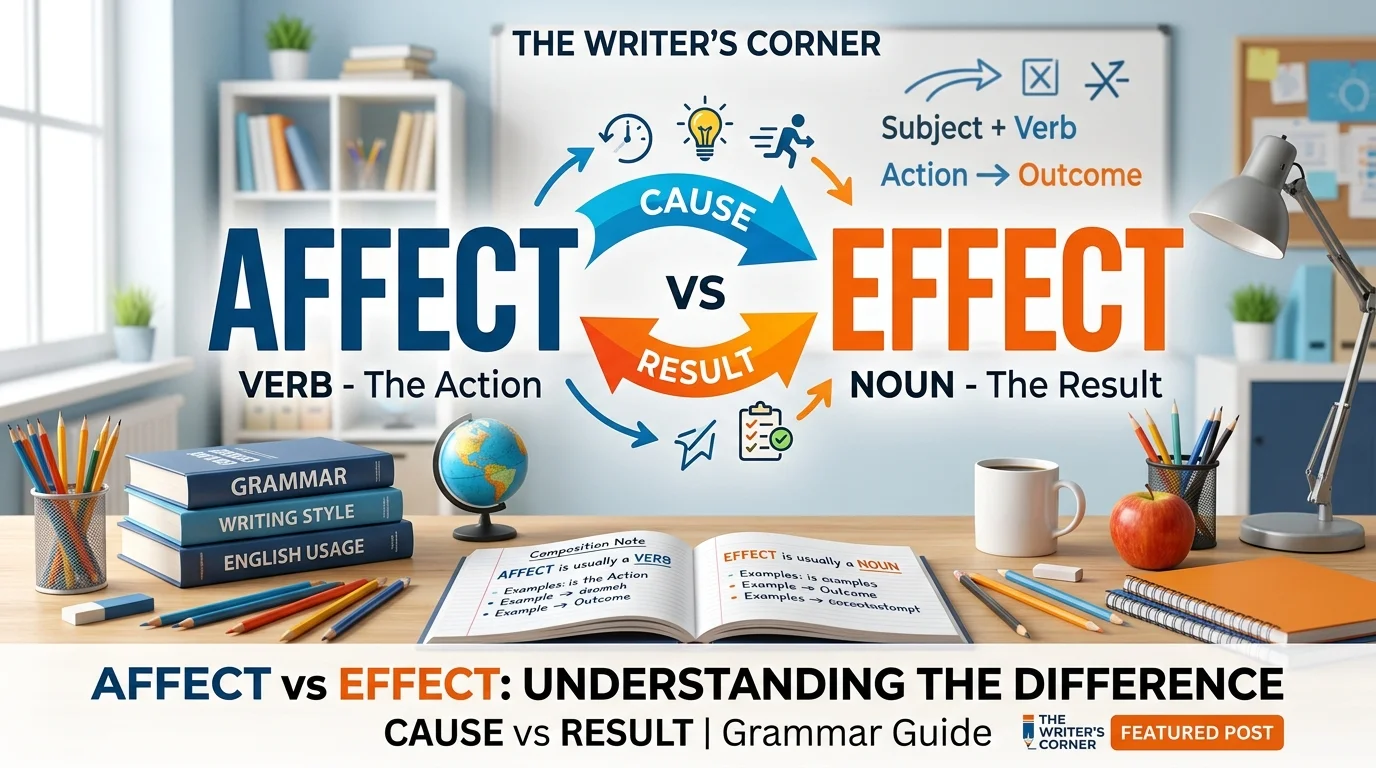

Have you ever paused while writing and wondered whether to use affect or effect? You’re not alone. The confusion between affect vs effect is one of the most common grammar mistakes in English. These two words look similar, sound related, and are often used in situations involving change or results. Because of this, many students, professionals, content writers, and even native English speakers mix them up.
Understanding the difference between affect vs effect can instantly improve your writing and communication skills. Whether you’re sending an email, writing an academic paper, posting on social media, or creating professional content, using the correct word helps your message appear clear and polished. In this complete guide, you’ll learn the meaning, definition, origin, usage, examples, common misconceptions, and practical tips to remember the difference forever. By the end, you’ll be able to use both words confidently without second-guessing yourself.
Meaning & Definition
The simplest way to understand affect vs effect is this:
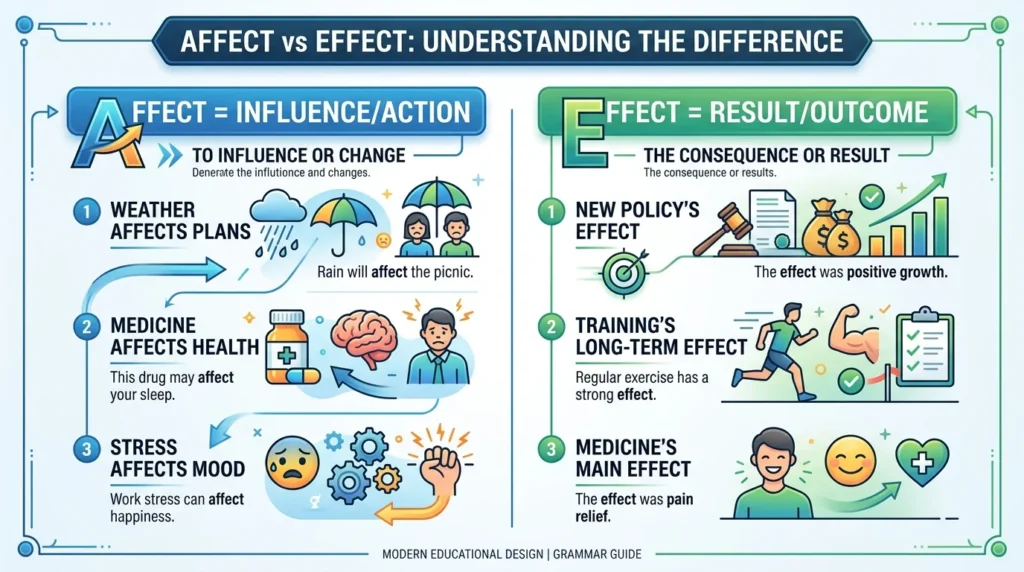
- Affect is usually a verb that means to influence, change, or impact something.
- Effect is usually a noun that means the result or outcome of a change.
In everyday English, people often use these words when talking about causes and results. Something affects another thing, and the change produced is the effect.
For example:
Lack of sleep can affect your concentration.
Poor concentration is the effect of not getting enough sleep.
This is the most common meaning and usage of both words. While there are some advanced exceptions, remembering this basic rule will help you use them correctly in most situations.
What Does Affect vs Effect Mean?
Featured Snippet Answer
The difference between affect vs effect is simple:
- Affect usually means to influence or change something and is commonly used as a verb.
- Effect usually means the result or consequence of a change and is commonly used as a noun.
Example:
- “The weather can affect your mood.”
- “A positive mood is the effect of good weather.”
A quick memory trick is:
Affect = Action (both start with A)
Effect = End Result (both start with E)
Background / Origin
The history of affect vs effect goes back to the Latin language. Both words originated from the Latin verb afficere, which meant “to influence,” “to act upon,” or “to do something to.” Over time, different forms of this root word entered the English language and developed distinct meanings.
The word affect entered English during the Middle Ages and was mainly used to describe the act of influencing a person, object, or situation. Writers and scholars used it when discussing emotions, behavior, and external influences. As English evolved, affect became strongly associated with actions that produce change.
The word effect developed from the Latin word effectus, meaning “accomplishment,” “result,” or “outcome.” Because of this origin, effect became linked to the consequences or results that occur after an action takes place.
Over hundreds of years, English speakers adopted a simple pattern: affect generally represents the action, while effect represents the result. This distinction remains the standard rule taught in schools, universities, and professional writing courses today.
Although there are rare exceptions in psychology and formal writing, the traditional meanings have remained remarkably consistent. Understanding the origin of these words helps explain why they are connected yet serve different grammatical purposes.
Usage in Different Contexts
General Usage
In everyday communication, affect and effect are used to explain relationships between actions and outcomes. Whenever something causes a change, affect is typically used to describe the influence, while effect describes what happened because of that influence.
For example, people may say that exercise affects health, education affects career opportunities, or technology affects communication habits. In each case, affect describes the influence being exerted. The resulting improvements or changes are considered effects.
Understanding this relationship makes it easier to choose the correct word. Ask yourself whether you’re describing an action or a result. If you’re talking about influence, affect is usually correct. If you’re talking about an outcome, effect is usually the right choice.
This rule applies to conversations, academic writing, business communication, journalism, blogging, and professional reports. Because both words appear frequently in written English, mastering their usage can significantly improve clarity and credibility.
Formal Usage
In formal writing such as academic papers, business reports, scientific studies, and legal documents, the distinction between affect and effect becomes especially important. Professional readers often expect precise grammar, and using the wrong word can create confusion or reduce credibility.
Researchers commonly write statements like:
“The treatment affected patient recovery.”
Here, affect describes the influence of the treatment. Later, they may write:
“The effect of the treatment was significant.”
In this sentence, effect refers to the result observed after the treatment.
Formal writing often analyzes causes and consequences, making both words essential. Understanding their proper use helps writers present information logically and professionally. Whether preparing a university assignment or drafting a company report, knowing the difference between affect vs effect demonstrates strong language skills.
Informal Usage
In casual conversations, social media posts, text messages, and everyday speech, people often confuse affect and effect. Because both words relate to change and outcomes, mistakes are common.
For example, someone might write:
“This movie effected my emotions.”
The correct sentence would be:
“This movie affected my emotions.”
Even though many people understand the intended meaning, using the correct word improves communication. In informal settings, grammar mistakes may not cause major problems, but understanding the difference still helps you communicate more effectively.
Social media users, bloggers, students, and professionals benefit from learning the correct usage because digital communication increasingly influences first impressions and credibility.
Affect vs Effect Meaning on Social Media Platforms
Although affect vs effect is primarily a grammar topic, people frequently search for these words while reading captions, comments, educational posts, and discussions online.
- WhatsApp → Users commonly discuss grammar questions in study groups and educational chats. Affect usually refers to influence, while effect refers to a result.
- Snapchat → Students and younger users often encounter these words in educational content, quizzes, and language-learning stories.
- TikTok → Grammar creators frequently explain affect vs effect through short videos, memory tricks, and examples to help viewers remember the difference.
- Instagram → Educational pages and language influencers often create infographics showing when to use affect and when to use effect in writing.
Other Meanings in Different Fields
While the common meanings remain the same, some specialized fields use these words differently.
- Medical → In psychology and psychiatry, affect can refer to a person’s observable emotional expression or emotional state.
- Physics → Effect often describes a measurable phenomenon, such as the greenhouse effect or photoelectric effect.
- Technology → Effect can refer to the outcome produced by software, hardware, or digital processes. Affect is used when discussing how technology influences behavior or systems.
Examples of Affect vs Effect in Sentences
Example 1
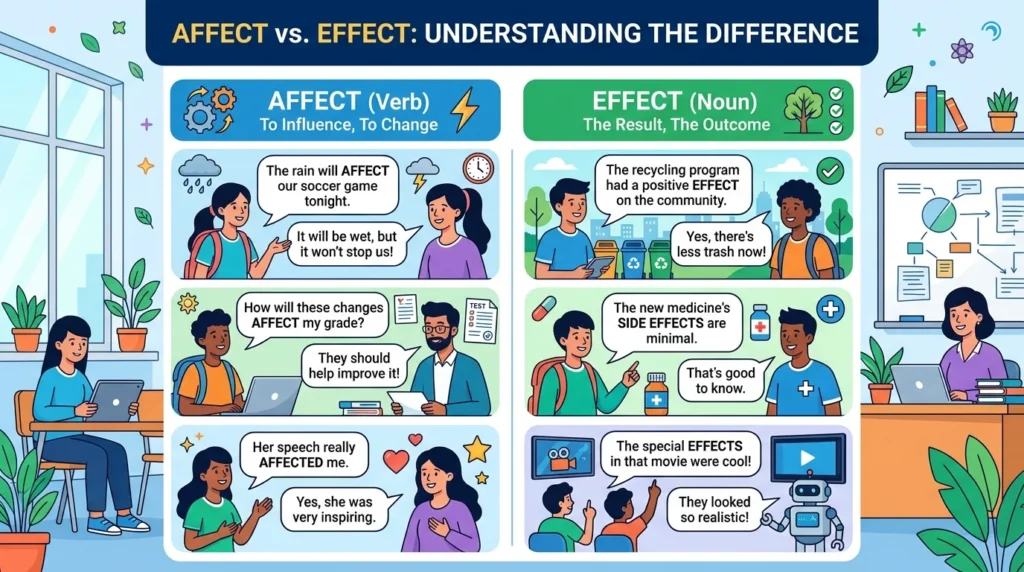
- Friend: “Does stress affect your sleep?”
- Reply: “Yes, the effect is that I wake up several times during the night.”
Example 2
- Teacher: “How does technology affect education?”
- Student: “One effect is easier access to information.”
Example 3
- Employee: “Will the new policy affect our work schedule?”
- Manager: “The effect will be fewer overtime hours.”
Example 4
- Parent: “Too much screen time can affect children.”
- Doctor: “One possible effect is reduced attention span.”
Common Misconceptions
- Misconception 1: Affect and effect mean exactly the same thing.
Reality: Affect is usually the action, while effect is usually the result. - Misconception 2: Effect is always correct because it sounds more formal.
Reality: Both words have different purposes and should be used accordingly. - Misconception 3: Native English speakers never confuse them.
Reality: Even experienced writers occasionally mix them up.
Similar Terms & Alternatives
- Influence – The ability to change or impact something.
- Impact – A strong effect or influence.
- Result – The outcome of an action.
- Consequence – Something that happens because of another event.
- Outcome – The final result.
- Change – A difference caused by an action.
- Modify – To alter or affect something.
- Cause – Something that produces an effect.
How to Respond to Affect vs Effect When Someone Uses It
When someone asks about affect vs effect, the best response is to explain the simple rule: affect is usually the action, and effect is usually the result. Providing an example often helps more than giving a technical grammar definition.
Possible replies:
- “Affect means to influence something, while effect means the result.”
- “Think of affect as the action and effect as the outcome.”
- “Affect changes something; effect is what happens afterward.”
Difference Between Affect vs Effect and Similar Terms
Many words describe influence and results, but affect and effect have specific grammatical roles. Affect typically functions as a verb, whereas effect typically functions as a noun. Words such as impact, consequence, outcome, and result overlap in meaning but do not always fit grammatically in the same way.
For example:
- Affect = influence
- Effect = result
- Impact = influence or result depending on context
- Consequence = result, often negative
- Outcome = final result
Understanding these distinctions helps improve accuracy in writing and speaking.
Affect vs Effect in Online Conversations & Dating Apps
Modern communication relies heavily on short messages, comments, captions, and direct conversations. Because people write quickly online, grammatical mistakes involving affect and effect are extremely common. Users often type without proofreading, causing confusion between the two words.
On dating apps, messaging platforms, and social networks, people may discuss how someone affects their emotions or the effect a relationship has on their life. For example, someone might say that a person’s kindness affects their mood positively. Another person may talk about the effect of regular communication on relationship satisfaction.
Content creators, influencers, educators, and bloggers frequently explain affect vs effect because search demand remains high. Grammar-related content consistently attracts students, professionals, and language learners looking to improve their writing skills.
Using affect and effect correctly in online communication can make messages appear more polished and professional. While small mistakes are usually understood, accurate language often creates a stronger impression, especially in professional networking, business communication, and educational settings.
As digital communication continues to grow, understanding common grammar distinctions such as affect vs effect remains valuable for anyone who writes online regularly.
Affect vs Effect From a Girl
When a girl uses the words affect or effect, the meaning usually depends on the sentence rather than any special hidden implication. For example, she might say:
“Your support affects me more than you realize.”
In this case, affect means influence. She is explaining how someone’s actions impact her feelings or experiences.
Similarly, she might say:
“The effect of your advice was amazing.”
Here, effect refers to the result produced by the advice.
In everyday conversations, messages, and social media interactions, girls generally use affect and effect according to their standard English meanings. Understanding the context of the sentence is more important than focusing on the speaker’s gender.
Affect vs Effect From a Guy
When a guy uses affect or effect, the interpretation remains the same. The words do not change meaning based on who says them. Instead, the surrounding sentence determines whether the speaker is describing influence or a result.
For example:
“The meeting affected my plans.”
This means the meeting influenced or changed his plans.
Another example:
“The effect of that decision was positive.”
This means a positive result came from the decision.
Whether the speaker is a friend, colleague, partner, or stranger, affect and effect maintain their standard definitions. Paying attention to context ensures accurate understanding.
Frequently Asked Questions
1. What is the easiest way to remember affect vs effect?
Remember: Affect = Action and Effect = End Result.
2. Is affect always a verb?
Usually yes, but in psychology it can also be a noun referring to emotional expression.
3. Is effect always a noun?
Usually yes, although it can occasionally be used as a verb meaning “to bring about.”
4. Which word is used more often?
Both are common, but affect is frequently used when discussing influence, while effect appears often when discussing results.
5. Why do people confuse affect and effect?
They have similar spellings, related meanings, and are often used in the same types of sentences.
Conclusion
Understanding affect vs effect is easier than many people think. The key distinction is that affect usually refers to the act of influencing or changing something, while effect refers to the result or outcome of that change. This simple rule works in most everyday situations and can help eliminate one of the most common grammar mistakes in English. Whether you’re writing an email, creating content, preparing an academic assignment, or participating in online conversations, using these words correctly improves clarity and professionalism. The relationship between the two words is straightforward: something affects a situation, and the resulting change is the effect. By remembering the simple memory trick—Affect = Action, Effect = End Result—you can confidently choose the correct word every time. As language continues to play an important role in digital communication, mastering commonly confused words like affect and effect helps you communicate more effectively, build credibility, and express your ideas with greater precision. The more you practice, the more natural the distinction becomes.
ALSO FIND OUT: Historic vs Historical: Meaning, Differences, Usage, Examples, and Common Mistakes