
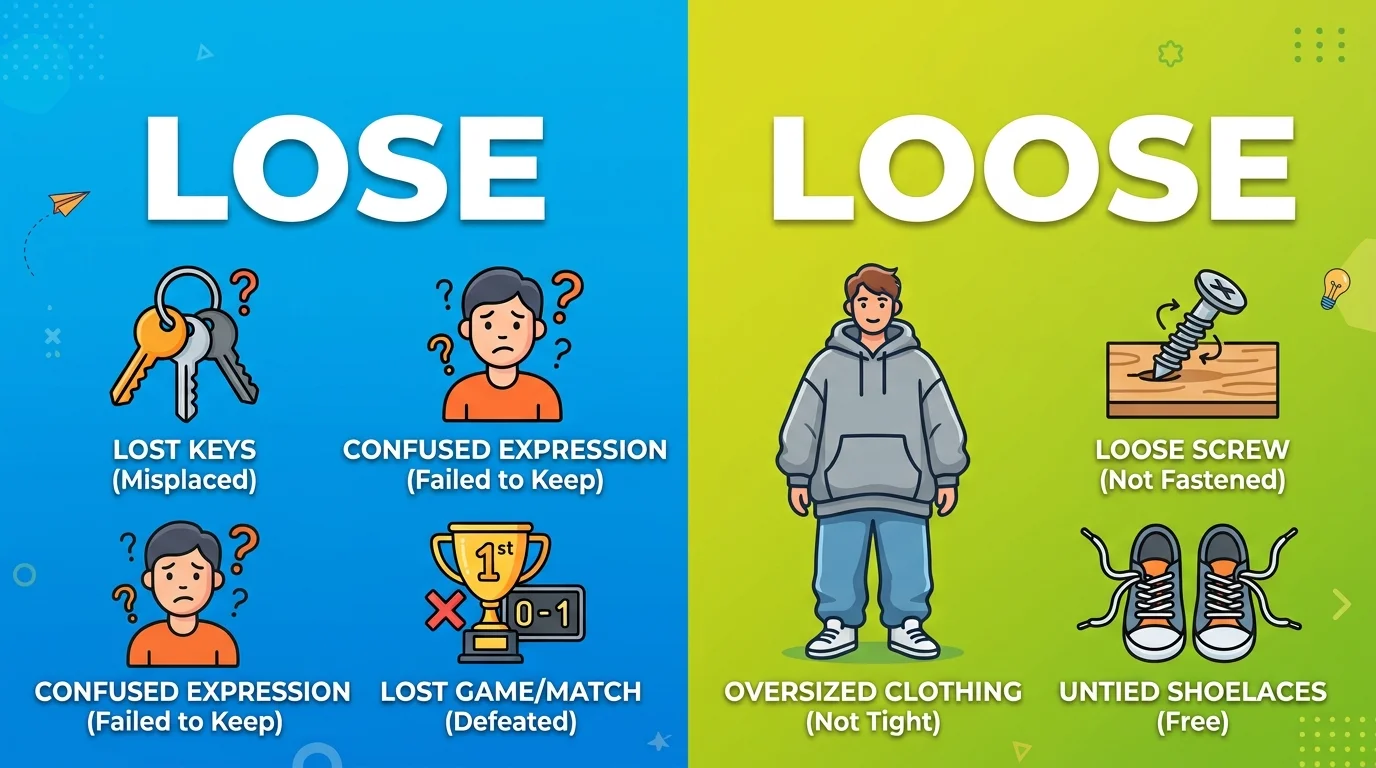

Have you ever written a sentence and wondered whether to use lose or loose? You are not alone. These two words are among the most commonly confused words in the English language because they look similar and sound somewhat alike. However, their meanings are completely different. Using the wrong one can change the meaning of your sentence and make your writing appear less professional.
Understanding the difference between lose vs loose is important for students, professionals, content creators, and anyone who communicates online. Whether you are sending a text message, posting on social media, writing an email, or creating content for a website, knowing when to use each word can help you avoid common mistakes. This guide explains everything in simple English, including definitions, origins, examples, social media meanings, misconceptions, and practical usage tips.
Meaning & Definition
The terms lose and loose are different words with different meanings.
Lose is a verb that means to fail to keep, fail to win, misplace something, or no longer have something.
Loose is usually an adjective that means not tight, not firmly attached, or free from restriction.
Most Common Meanings
- Lose = to misplace, fail to win, or be deprived of something.
- Loose = not tight, free-moving, or not securely fastened.
Although the spelling differs by only one letter, using the wrong word can completely change what you are trying to say.
What Does Lose vs Loose Mean?
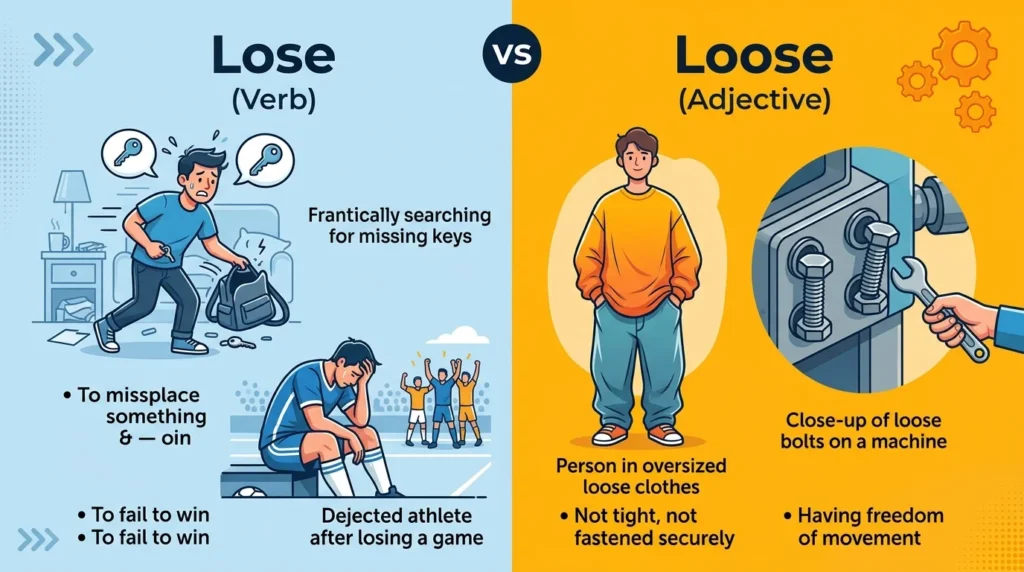
Lose means to no longer have something, fail to win, or be unable to find something.
Loose means not tight, not fixed firmly, or free to move.
Quick Featured Snippet Answer
- Lose = Verb (action word)
- Example: “I don’t want to lose my keys.”
- Loose = Adjective (describing word)
- Example: “My shirt is loose.”
The easiest way to remember is that lose is something you do, while loose describes something.
Background / Origin
The confusion between lose and loose is not new. Their histories go back hundreds of years in the English language. Although the words are related to old Germanic roots, they evolved into separate terms with different meanings and grammatical functions.
The word lose comes from the Old English word losian, which meant “to perish,” “be destroyed,” or “cease to possess.” Over time, the meaning expanded to include losing possessions, competitions, opportunities, and even emotions. Today, it remains one of the most commonly used verbs in English.
The word loose comes from the Old Norse word lauss, meaning “free,” “unbound,” or “not attached.” This meaning remains largely unchanged. Modern English speakers use it to describe clothing, screws, ropes, rules, and anything that is not tightly secured.
One reason people confuse these words is pronunciation. Many learners assume similar-looking words have similar meanings. In reality, lose and loose belong to different grammatical categories and serve completely different purposes.
As English became more widely used online, spelling mistakes involving these words became increasingly common. Search engines, social media platforms, and messaging apps now contain countless examples where users accidentally write “loose” instead of “lose” or vice versa. Understanding their origins helps explain why they are separate words and why using the correct form matters.
Usage in Different Contexts
General Usage
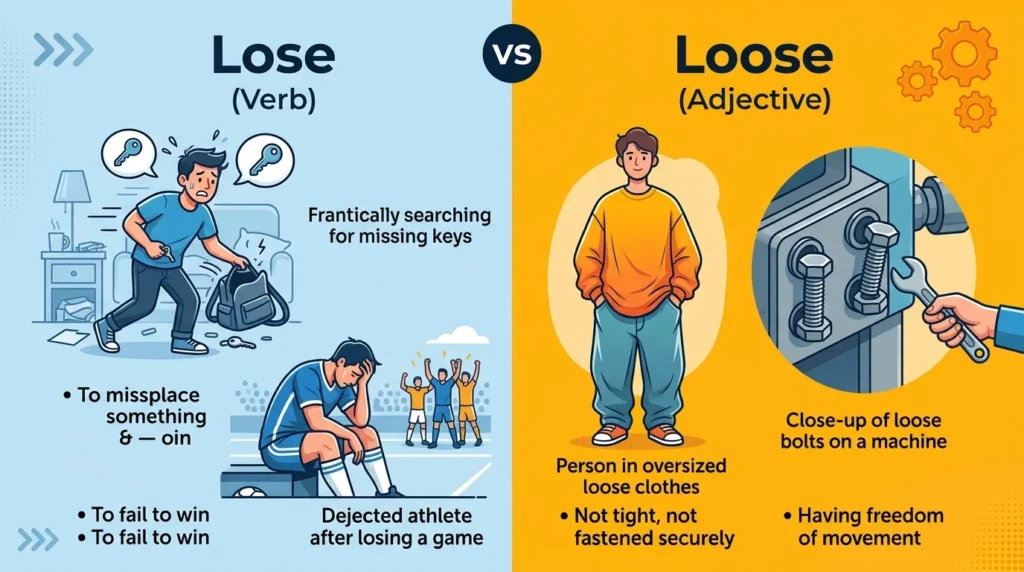
In everyday English, both words appear frequently but in different situations. Lose is used when talking about failure, absence, misplacement, or reduction. You can lose a game, lose your phone, lose money, lose weight, or lose an opportunity. It always involves an action or event where something is no longer retained.
Loose, on the other hand, describes a condition. A loose screw, loose shoelace, loose shirt, or loose connection all indicate that something is not tight or secure. The word can also describe relaxed situations, such as loose rules or loose interpretations.
Understanding the role of each word makes communication clearer. If someone says they “loose their wallet,” readers will often understand the intended meaning, but the sentence is grammatically incorrect. Proper usage helps create professional and accurate writing.
Formal Usage
In formal writing, academic documents, business emails, professional reports, and published content, the distinction between lose and loose is extremely important. Editors and employers often notice these mistakes because they are among the most common spelling errors in English.
When writing professionally, lose should only be used as a verb. Examples include losing market share, losing a customer, losing access, or losing a contract. Formal communication values precision, and incorrect usage can reduce credibility.
Loose is generally used as an adjective in formal contexts. Businesses may refer to loose regulations, engineers may discuss loose components, and fashion experts may describe loose-fitting clothing. Because formal writing emphasizes accuracy, correctly distinguishing these words demonstrates strong language skills and attention to detail.
Informal Usage
In informal communication, such as texting, social media comments, online gaming chats, and casual conversations, mistakes between lose and loose are very common. Many users type quickly and accidentally substitute one word for the other.
For example, gamers frequently write “Don’t loose the match!” when they actually mean “Don’t lose the match!” Similarly, social media users may post comments containing the incorrect spelling without realizing it.
Although informal environments are more forgiving, using the correct word still improves clarity and helps avoid misunderstandings. Consistently using proper spelling can also make messages appear more polished and easier to understand.
Lose vs Loose Meaning on Social Media Platforms
Social media users often use these words in everyday conversations, captions, comments, and messages.
- Lose is commonly used when discussing missed opportunities, forgotten items, or losing games.
- Example: “Don’t lose the ticket before the event.”
- Loose is usually used when describing clothing, accessories, or objects that are not tight.
Snapchat
- Users often use lose in streak-related conversations.
- Example: “We almost lost our streak.”
- Loose may appear when discussing fashion, outfits, or appearances.
TikTok
- Fitness creators frequently use lose in phrases like “lose weight” or “lose fat.”
- Fashion creators use loose when describing oversized clothing trends.
- Lose commonly appears in motivational content about losing fear, losing weight, or losing bad habits.
- Loose appears in fashion captions discussing loose jeans, loose dresses, and relaxed styles.
Other Meanings in Different Fields
Medical
- Lose may refer to losing weight, losing blood, or losing consciousness.
- Loose can describe loose bowel movements or loose joints.
Physics
- Lose may refer to losing energy during a process.
- Loose can describe loosely connected particles or structures.
Technology
- Lose refers to losing data, losing access, or losing connectivity.
- Loose describes loose cables, loose hardware components, or loose connections.
Examples of Lose vs Loose in Sentences
Example 1
- Friend: “Where are your keys?”
- You: “I think I might lose them if I keep carrying so many things.”
Example 2
- Friend: “Why are you changing clothes?”
- You: “These pants are too loose for me now.”
Example 3
- Gamer: “We cannot lose this match.”
- Teammate: “Stay focused and we will win.”
Example 4
- Mechanic: “The wheel feels loose.”
- Customer: “Thanks for checking it before it became dangerous.”
Common Misconceptions
Misconception 1
- Lose and loose mean the same thing.
- Reality: They have completely different meanings and grammatical roles.
Misconception 2
- Loose is just another spelling of lose.
- Reality: Loose is a separate word that usually functions as an adjective.
Misconception 3
- The mistake is acceptable in professional writing.
- Reality: Professional writers, editors, and employers generally expect correct usage.
Similar Terms & Alternatives
- Lose – Fail to keep, misplace, or fail to win.
- Misplace – Put something in the wrong location.
- Forfeit – Give up something voluntarily or as a penalty.
- Miss – Fail to experience or obtain something.
- Loose – Not tight or firmly secured.
- Relaxed – Free from tension or strictness.
- Unfastened – Not attached securely.
- Free – Not restricted or confined.
How to Respond to Lose vs Loose When Someone Uses It
When someone incorrectly uses lose and loose, it is usually a simple spelling mistake rather than a misunderstanding. A polite correction is often enough.
Possible Responses
- “I think you mean lose, not loose.”
- “Easy mistake—lose means misplace or fail to win, while loose means not tight.”
- “Those two words confuse many people, but they have different meanings.”
Difference Between Lose and Similar Terms
| Term | Meaning |
|---|---|
| Lose | To no longer have something |
| Misplace | To put something in the wrong place |
| Forfeit | To give up something as a penalty |
| Miss | To fail to obtain or experience |
| Loose | Not tight or secure |
| Relaxed | Free from tension or pressure |
The key difference is that lose describes an action, while many related words describe specific situations. Loose is different altogether because it usually describes a condition rather than an action.
Relevance in Online Conversations & Dating Apps
In modern digital communication, correct spelling matters more than many people realize. Dating apps, messaging platforms, social networks, and professional networking sites all rely heavily on written communication. Because users often form first impressions based on text alone, spelling mistakes can influence how messages are perceived.
The confusion between lose and loose frequently appears in dating app profiles and conversations. Someone might write, “I don’t want to loose this connection,” when the correct phrase is “lose this connection.” While most people understand the intended meaning, repeated mistakes can make communication seem less polished.
Online conversations move quickly, which increases the likelihood of typing errors. Social media users often prioritize speed over accuracy. However, content creators, influencers, marketers, and professionals benefit from using correct grammar because it improves credibility and audience trust.
Search engines, educational platforms, and AI tools also emphasize accurate language. Correctly using lose and loose helps content rank better, appear more professional, and communicate ideas clearly. Whether you are chatting with friends, building relationships online, or creating content, understanding the difference between these words contributes to more effective communication.
Lose vs Loose from a Girl
When a girl uses the words lose or loose, the meaning generally remains the same as standard English. Context determines the intended message.
For example:
- “I don’t want to lose you” often expresses emotional attachment or concern.
- “My hoodie is loose” simply describes clothing.
In texting and social media conversations, many people accidentally type “loose” when they mean “lose.” Therefore, it is important to look at the surrounding message rather than assuming a special hidden meaning.
If a girl says, “I don’t want to lose our friendship,” she is usually expressing that she values the relationship and does not want it to end. The word carries emotional significance because it refers to losing a connection, opportunity, or person.
Lose vs Loose from a Guy
When a guy uses lose or loose, the interpretation also depends on context rather than gender.
Examples include:
- “I don’t want to lose this opportunity.”
- “These shoes feel loose.”
If a guy says, “I don’t want to lose you,” the statement often suggests that he values the relationship or connection. Meanwhile, “loose” is usually descriptive and may refer to clothing, objects, or physical conditions.
Because texting culture encourages fast typing, spelling mistakes are common. It is always helpful to consider the overall context before interpreting deeper meaning from the word choice alone.
Frequently Asked Questions
1. What is the difference between lose and loose?
Lose means to misplace something or fail to win. Loose means not tight or not firmly attached.
2. Is it lose weight or loose weight?
The correct phrase is lose weight because lose is the verb meaning to reduce or get rid of something.
3. Why do people confuse lose and loose?
They look similar, sound somewhat alike, and are among the most frequently misspelled words in English.
4. Can loose be used as a verb?
Yes, but it is less common. It can mean to release or set free. However, most people use it as an adjective.
5. How can I remember the difference?
Remember that lose is an action, while loose describes something that is not tight.
ALSO READ: Affect vs Effect: Meaning, Difference, Usage, Examples & Common Mistakes Explained
Conclusion
The difference between lose vs loose may seem small, but it has a major impact on clear communication. Lose is a verb that refers to misplacing something, failing to win, or no longer having something. Loose is typically an adjective that describes something not tight, not secure, or free-moving. Because the two words look similar, many people accidentally interchange them in emails, social media posts, text messages, and professional writing. Understanding their meanings, origins, and correct usage helps eliminate one of the most common English spelling mistakes. Whether you are writing academic content, chatting with friends, creating online content, or using dating apps, choosing the correct word improves clarity and credibility. A simple rule to remember is that lose is something you do, while loose is something you describe. By practicing the examples and tips covered in this guide, you can confidently use both words correctly and avoid confusion in any situation.
Find out: Historic vs Historical: Meaning, Differences, Usage, Examples, and Common Mistakes