

Have you ever read a sentence and wondered whether the correct word is compliment or complement? If so, you’re not alone. The confusion between compliment vs complement is one of the most common English grammar mistakes because both words sound exactly alike but have completely different meanings. Many students, writers, professionals, and even native English speakers accidentally use one when they actually mean the other.
Understanding the difference between compliment vs complement can instantly improve your writing and communication skills. Whether you’re writing an email, posting on social media, preparing an academic assignment, or having a professional conversation, using the right word helps you communicate clearly and confidently. The good news is that the distinction is easier than it seems. Once you learn the meanings, origins, and practical examples, you’ll rarely confuse them again. This guide explains everything in simple English, making it easy for anyone to understand and remember.
Meaning & Definition
The difference between compliment and complement is based on what each word represents.
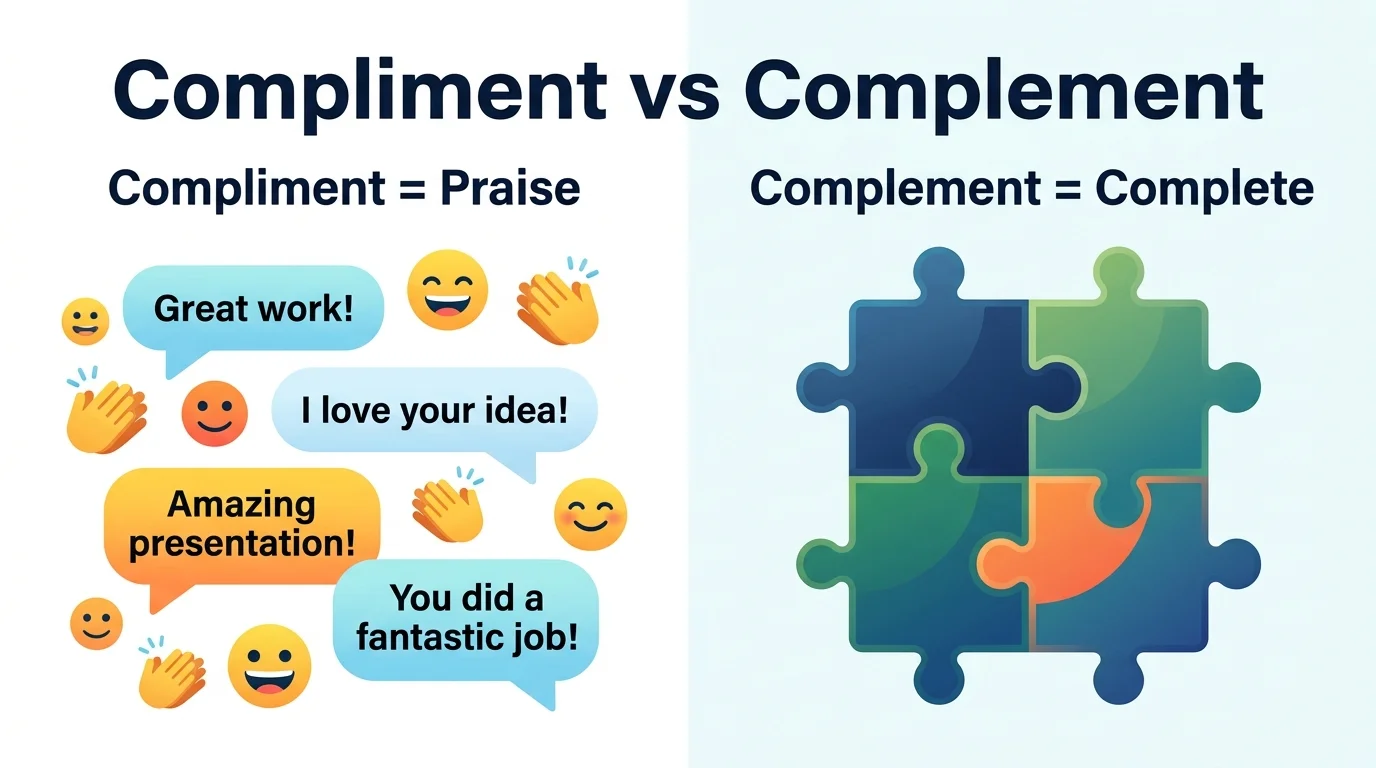
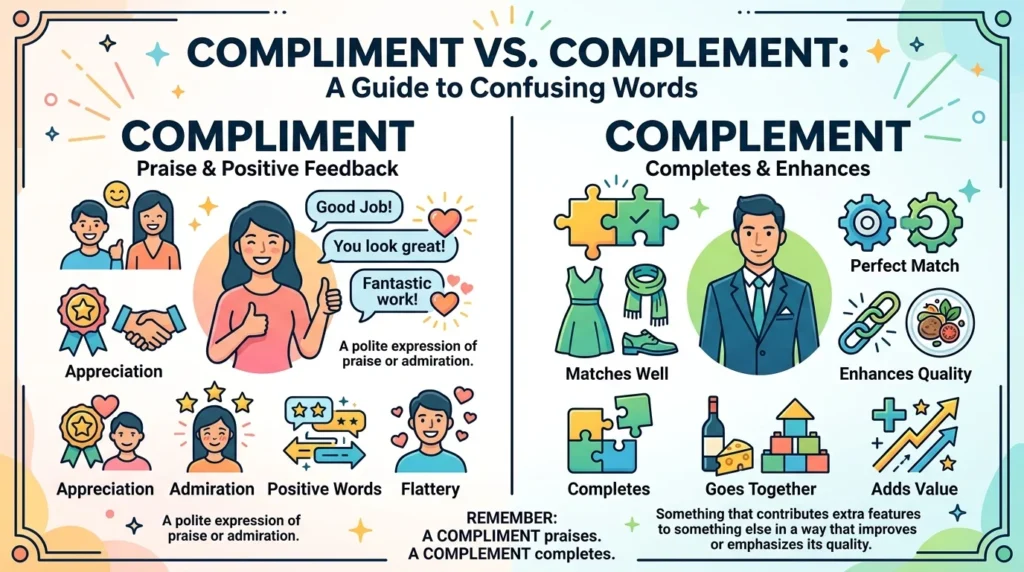
- Compliment means a polite praise, kind remark, or expression of admiration.
- Complement means something that completes, improves, enhances, or goes well with something else.
For example:
“She gave me a compliment about my presentation.”
Here, compliment means praise.
“The blue tie complements his suit perfectly.”
Here, complement means enhancing or completing something.
The most common meaning people search for is compliment, which refers to saying something nice about a person. However, complement is equally important because it describes things that fit together naturally or improve each other.
What Does Compliment vs Complement Mean?
Featured Snippet Answer
Compliment vs complement refers to two commonly confused words with different meanings:
- Compliment = praise, admiration, or a positive remark.
- Complement = something that completes, improves, or matches another thing.
Example:
- “Your speech deserves a compliment.”
- “That jacket complements your outfit.”
A simple memory trick:
Compliment = I like it (contains “i”)
Complement = Complete (both start with “comple”)
Background / Origin
The confusion between compliment vs complement becomes easier to understand when you know their origins. Although these words sound identical, they come from different historical roots and developed separate meanings over time.
The word compliment originates from the Latin word complere, which later evolved through French and Italian influences into a term associated with courteous behavior, respect, and expressions of admiration. By the 17th century, English speakers commonly used compliment to describe praise, flattery, and polite social remarks.
The word complement also traces back to the Latin word complere, meaning “to fill up” or “to complete.” However, its meaning evolved differently. Instead of focusing on praise, complement became associated with completion, enhancement, and things that work well together. In English, it was often used to describe something that makes another thing whole or perfect.
Over time, the spellings diverged, but the pronunciation remained nearly identical. This is why many people still confuse them today. Despite sounding the same, the meanings remain distinct. Compliment relates to praise and positive words, while complement relates to completion and harmony. Understanding their origins helps explain why these two words look similar yet serve completely different purposes in modern English.
Usage in Different Contexts
General Usage
In everyday communication, compliment is used whenever someone expresses appreciation, admiration, or praise. People give compliments about appearance, achievements, skills, personality, and accomplishments. A compliment can make someone feel valued, appreciated, and confident. For example, telling someone they did an excellent job at work or that they look great today is considered a compliment.
On the other hand, complement is used when discussing things that improve, complete, or work well with one another. For example, a well-designed website may complement a company’s brand identity. Similarly, certain colors complement each other because they create a balanced visual appearance. In daily conversations, complement often appears when discussing relationships between objects, ideas, designs, foods, or personal qualities.
Understanding whether you’re talking about praise or completion will usually help you choose the correct word immediately.
Formal Usage
In professional and academic settings, both words appear regularly but serve different functions. Compliment is often used in customer service, workplace evaluations, recommendation letters, and formal communications where appreciation is expressed. For instance, a manager may compliment an employee for exceptional performance, or a professor may compliment a student on excellent research work.
Complement frequently appears in business, design, marketing, and academic writing. Companies may describe products that complement one another, while researchers may discuss factors that complement a theory or methodology. Because formal writing values precision, using the wrong word can affect clarity and professionalism.
Understanding the distinction is particularly important in professional communication because readers often notice grammar and vocabulary accuracy. Correct usage demonstrates strong language skills and attention to detail.
Informal Usage
In casual conversations, text messages, and social media interactions, compliment is much more common than complement. People frequently exchange compliments about photos, achievements, fashion choices, and personal milestones. Phrases such as “Thanks for the compliment” or “That’s a nice compliment” are widely used in everyday communication.
Complement also appears informally, especially when discussing matching items or compatible qualities. Someone might say that a handbag complements an outfit or that two friends complement each other’s personalities. Although less common in casual conversation, complement remains important because it accurately describes things that fit together well.
Compliment vs Complement Meaning on Social Media Platforms
Many people encounter the phrase compliment vs complement while reading captions, comments, educational content, and grammar discussions online.
- WhatsApp → Users often search for the difference when sending messages, compliments, or discussing grammar in study groups.
- Snapchat → Educational creators frequently explain compliment vs complement through quick language-learning stories and quizzes.
- TikTok → Grammar influencers use short videos to teach memory tricks that help viewers remember the difference.
- Instagram → Language pages often post visual infographics showing examples of compliment and complement in real-life situations.
Other Meanings in Different Fields
Although the standard meanings are the most common, these words can have specialized uses.
- Medical → Complement refers to the complement system, a group of proteins that support the immune system in fighting infections.
- Physics → Complement can refer to a component or element that completes a larger system or process.
- Technology → Complement often describes software, hardware, or features that work together to improve performance and user experience.
Examples of Compliment vs Complement in Sentences
Example 1
- Friend: “I love your presentation today.”
- Reply: “Thank you for the compliment. I worked really hard on it.”
Example 2
- Shopper: “Does this tie look good with my suit?”
- Friend: “Yes, it complements your suit perfectly.”
Example 3
- Manager: “Your leadership skills have improved significantly.”
- Employee: “I appreciate the compliment.”
Example 4
- Designer: “The gold accents complement the dark background beautifully.”
- Client: “That’s exactly the look I wanted.”
Common Misconceptions
- Misconception 1: Compliment and complement mean the same thing.Reality: Compliment means praise, while complement means to complete or enhance.
- Misconception 2: The spelling difference doesn’t matter.Reality: Using the wrong word can completely change the meaning of a sentence.
- Misconception 3: Complement is rarely used.Reality: Complement is widely used in design, business, education, fashion, and professional writing.
Similar Terms & Alternatives
- Praise – Expressing admiration or approval.
- Admiration – Respect or appreciation for someone.
- Appreciation – Recognition of value or achievement.
- Enhance – Improve the quality of something.
- Complete – Make something whole.
- Match – Pair well with another thing.
- Support – Strengthen or assist.
- Improve – Make something better.
How to Respond to Compliment vs Complement When Someone Uses It
When someone asks about compliment vs complement, the easiest response is to explain whether the sentence involves praise or completion. This simple distinction solves most confusion immediately.
Possible replies:
- “Compliment means praise; complement means something that completes another thing.”
- “If you’re saying something nice, use compliment.”
- “If two things work well together, use complement.”
Difference Between Compliment vs Complement and Similar Terms
Although compliment and complement are unique words, they share similarities with several related terms. Compliment is closely related to praise, admiration, appreciation, and approval because all involve positive recognition. However, compliment specifically refers to a spoken or written expression of praise.
Complement is more closely related to enhance, complete, match, and support. It describes how one thing improves, balances, or completes another. For example, matching colors may complement each other, while a compliment would be a positive comment about those colors.
The key difference remains simple: compliments are words of praise, while complements are things that work together effectively.
Compliment vs Complement in Online Conversations & Dating Apps
In today’s digital world, understanding compliment vs complement is especially useful because communication happens largely through texts, social media posts, and online interactions. On dating apps, compliments are extremely common. People often compliment someone’s appearance, personality, interests, or achievements as a way to start conversations and build connections.
For example, someone might say, “You have a great smile,” which is clearly a compliment. Positive remarks help create friendly and engaging conversations. Compliments are often used as conversation starters because they show interest and appreciation.
Complement, however, appears when discussing compatibility. Someone may say that two personalities complement each other or that shared interests complement a relationship. In this context, complement refers to qualities that fit together well and create balance.
Both words play important roles in modern communication. Compliments help build confidence and strengthen social interactions, while complements describe compatibility and harmony between people, ideas, or interests. Understanding the difference helps users communicate more accurately on dating apps, social media platforms, and messaging services.
Compliment vs Complement From a Girl
When a girl uses compliment, she is usually expressing admiration, appreciation, or kindness. For example, if she says, “You have a great sense of humor,” she is giving a compliment. Compliments often indicate friendliness, respect, encouragement, or appreciation.
When she uses complement, she is generally describing compatibility or balance. For example:
“Your creativity complements my organizational skills.”
This means the two qualities work well together.
The meaning depends on context, but the grammar rules remain the same. Compliment refers to praise, while complement refers to something that enhances or completes another thing.
Compliment vs Complement From a Guy
When a guy uses compliment, the meaning is usually straightforward praise or appreciation. For example:
“You did an amazing job on that project.”
This is a compliment because it expresses admiration.
When he uses complement, he is likely discussing compatibility or improvement. For example:
“Your skills complement the team’s strengths.”
This means the skills work together effectively.
Whether spoken by a man or woman, the meanings do not change. Understanding the surrounding sentence is the best way to determine whether the word refers to praise or completion.
Frequently Asked Questions
1. What is the difference between compliment and complement?
Compliment means praise or admiration, while complement means something that completes or improves another thing.
2. How do I remember compliment vs complement?
Remember that compliment contains “i” like “I like you,” while complement relates to completing something.
3. Can complement be used as a verb?
Yes. Complement can mean to improve, complete, or enhance something.
4. Is compliment always positive?
Yes. A compliment is generally a positive remark or expression of appreciation.
5. Why are compliment and complement confusing?
They are homophones, meaning they sound the same but have different spellings and meanings.
Also read: Historic vs Historical: Meaning, Differences, Usage, Examples, and Common Mistakes
Conclusion
Understanding compliment vs complement is essential for clear and accurate communication. Although these two words sound identical, their meanings are completely different. A compliment is a kind remark, expression of admiration, or positive feedback given to someone. A complement, on the other hand, is something that completes, improves, enhances, or works well with another thing. The easiest way to remember the difference is to associate compliment with praise and complement with completion. Whether you’re writing professional emails, creating content, participating in online discussions, or communicating on social media, using the correct word improves clarity and credibility. Many people confuse these terms because they are pronounced the same way, but understanding their meanings makes choosing the right word much easier. By practicing real-life examples and remembering simple memory tricks, you can confidently use compliment and complement in any situation. Mastering this distinction not only strengthens your grammar skills but also helps you communicate more effectively in both personal and professional settings.
Also read: Affect vs Effect: Meaning, Difference, Usage, Examples & Common Mistakes Explained