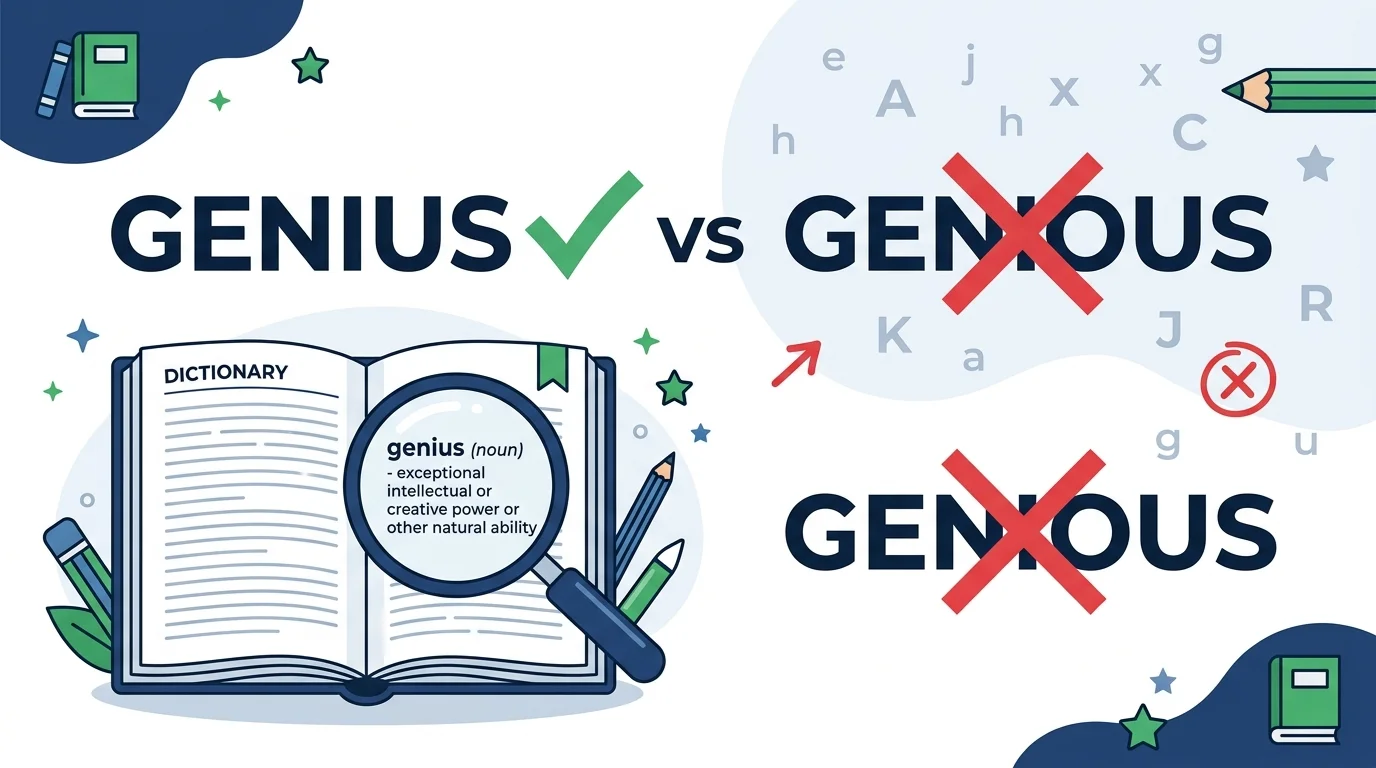

Have you ever typed a word, looked at it twice, and suddenly wondered whether it is actually spelled correctly? Genius vs Genious is one of those surprisingly common English spelling confusions. Both forms look believable, and the pronunciation can make the wrong version seem natural. But there is an important difference: genius is the correct standard-English spelling, while genious is normally a misspelling of genius. The word genius can describe exceptional intelligence, creativity, talent, or a person who shows an unusually high level of ability. It is also commonly used online as a casual compliment, such as “That idea is genius!” Oxford Learner’s Dictionaries+1
So why do people write “genious”? Why does the mistake happen so often? Does “genious” have a different meaning on WhatsApp, Snapchat, TikTok, or Instagram? And what does it mean when a girl or a guy calls you “genius”? This guide answers all of those questions in simple English.
Meaning & Definition
The simplest answer to Genius vs Genious is that genius is correct and genious is incorrect when you mean the English word for exceptional intelligence or ability. A genius can be a person who has extraordinary intellectual, creative, artistic, scientific, or practical ability. The word can also refer to the exceptional ability itself. For example, “She is a genius” describes a highly capable person, while “His genius changed the field” refers to exceptional ability or creativity. Major dictionaries define genius in these ways, including unusually great intelligence, skill, artistic ability, or a person possessing such qualities. Oxford Learner’s Dictionaries+1
The spelling genious does not normally have a separate standard-English meaning. In ordinary writing, it is simply a spelling error for genius. The confusion is understandable because English has many familiar words ending in -ious, such as “serious,” “curious,” and “obvious.” This can make “genious” look as if it follows the same pattern. It does not. The correct ending is -ius, giving us GEN-I-US.
Another source of confusion is ingenious, which is a real English word. “Ingenious” means clever, inventive, or skillfully designed, while “genius” is mainly a noun referring to exceptional ability or a person with that ability. grammarexplore.com+1
What Does Genius Vs Genious Mean?
Genius is the correct spelling. Genious is a common misspelling and is not the standard spelling of a separate English word.
In simple terms:
- Genius = a person with exceptional intelligence, talent, creativity, or ability; it can also mean exceptional ability itself.
- Genious = normally an incorrect spelling of genius.
- Ingenious = a different correct word meaning clever, inventive, or skillful.
For example, “She is a mathematical genius” is correct. “She is a mathematical genious” is incorrect. If you are writing an email, school assignment, article, CV, social-media post, or professional message, use genius. Oxford, Cambridge, and other established dictionaries list genius as the standard word. Oxford Learner’s Dictionaries+1
Background / Origin
The history of genius is much older than its modern meaning suggests. The English word came through Middle English from the Latin genius. In ancient Roman culture, a genius was associated with a guiding or guardian spirit connected with a person, family, place, or institution. Over time, the meaning developed from the idea of an individual’s distinctive nature or innate ability toward the modern meaning of exceptional natural talent and intellectual or creative ability. American Heritage Dictionary+1
According to Oxford, the word entered English through Latin and gradually developed through several related meanings. The modern sense of exceptional natural ability emerged later than the original Roman sense. The historical development helps explain why genius has such a distinctive spelling. It is not formed by simply adding the common English ending “-ious.” Oxford Learner’s Dictionaries
This is also why the spelling genious should not be treated as an alternative version. English spelling often preserves historical forms that do not look completely predictable from pronunciation. Once you remember that the word is genius, the spelling becomes much easier: gen + ius, not gen + ious.
Usage in Different Contexts
General Usage
In everyday English, genius is usually used in one of two ways. First, it can describe a person who has extraordinary intelligence, creativity, talent, or ability. You might say, “Marie is a programming genius,” meaning she has exceptional ability in programming. Second, it can describe an exceptional quality, idea, solution, or achievement. For example, “That was a stroke of genius” means the idea was remarkably clever or effective. Cambridge and Oxford both recognize these core meanings. Oxford Learner’s Dictionaries+1
In casual conversation, people also use genius as enthusiastic praise. Someone might say, “You’re a genius!” after a friend solves a difficult problem or finds an easy solution. In this situation, the speaker may not literally be claiming that the person has extraordinary intellectual ability. It can simply mean, “That was very smart.”
Formal vs Informal Usage
In formal writing, genius should be used when its meaning genuinely fits the context. For example, “The artist demonstrated exceptional creative genius” sounds appropriate in an academic or critical discussion. In professional writing, however, more precise words such as “expert,” “innovative,” “highly skilled,” or “creative” may sometimes communicate the intended idea more accurately.
In informal communication, genius is much more flexible. Friends may say, “You’re a genius,” “That idea is genius,” or “Genius move!” These expressions are common in chats, comments, memes, and social media. Oxford also recognizes genius as an informal adjective meaning showing unusually great intelligence, skill, or artistic ability. Oxford Learner’s Dictionaries
Genius Vs Genious Meaning on Social Media Platforms
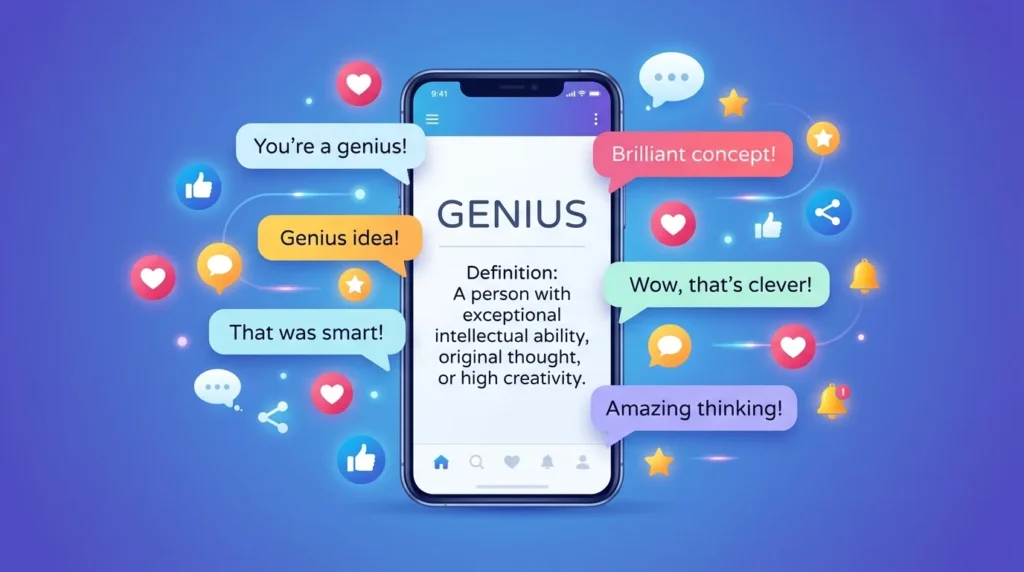
There is no separate dictionary meaning of “genious” on social media. If someone types “genious,” they usually mean genius and have simply made a spelling mistake. The word genius, however, is commonly used as casual praise.
- WhatsApp → If someone messages “You’re a genius 😂,” they are usually complimenting you for being clever, solving a problem, or having a good idea. The tone can be serious, friendly, or humorous depending on the conversation.
- Snapchat → “Genius” may appear as a quick compliment after someone shares a clever trick, funny idea, solution, or creative snap. It does not automatically carry a romantic meaning.
- TikTok → Users may call a video, trick, joke, hack, or creator “genius” when they think the idea is especially clever. “That is genius” often means “That is extremely smart or creative.”
- Instagram → “Genius” can appear in comments, captions, DMs, or reactions. Someone might call your idea, design, photo concept, business strategy, or joke “genius.” The meaning depends on what was posted and the relationship between the people.
The important point is that social media does not turn “genious” into a new standard word. If you see the misspelling online, the intended word is generally genius.
Other Meanings in Different Fields
The word genius can appear across many subjects, but it does not suddenly become a specialized technical term just because it is used in a particular field. Its basic meaning remains connected to exceptional ability, talent, creativity, or intelligence.
- Medical → “Genius” is not, by itself, a standard medical diagnosis or clinical condition. A doctor would not normally use “genius” as a medical classification. In medical or psychological discussions, more precise terms are used when describing cognitive abilities, learning, development, or performance.
- Physics → “Genius” is not a standard physics measurement or scientific unit. A physicist might describe an unusually innovative scientist or breakthrough as “genius” in ordinary language, but the word itself is not a technical physics concept.
- Technology → In technology, genius is commonly used informally to praise an innovative product, clever feature, elegant solution, programmer, engineer, or technical idea. For example, “That interface design is genius” means the speaker thinks the design is exceptionally clever.
This distinction matters because online articles sometimes make ordinary words sound like they have specialized meanings in every field. In reality, genius remains a general English word, while technical fields use their own precise terminology.
Examples of Genius Vs Genious in Sentences
Here are four natural examples showing how the word appears in everyday communication:
- Example 1 — Chat-style compliment: “You remembered the shortcut I told you about? You’re a genius 😂.” Here, genius is a friendly compliment. The speaker is saying the other person was smart or helpful, not necessarily making a scientific judgment about intelligence.
- Example 2 — Clever idea: “Wait, putting the files into one folder before sending them is actually genius.” Here, genius is being used informally to praise an idea or solution. The sentence does not mean the folder itself has intelligence.
- Example 3 — Formal context: “Her innovative research demonstrated exceptional scientific ability and creative genius.” In this sentence, genius refers to unusually high creative or intellectual ability and fits a more formal discussion.
- Example 4 — Correcting the spelling: “I almost wrote ‘genious’ in my email, but then I remembered it is spelled genius.” This example directly shows the spelling difference. The correct form is genius, with no “o” between the “i” and “u.”
Common Misconceptions
- Misconception 1: “Genius and genious are two different words.”
In standard modern English, this is generally false. Genius is the correct word for exceptional intelligence, talent, or ability. Genious is normally a misspelling. Word Differences+1 - Misconception 2: “Genious is the adjective form of genius.”
Not quite. The word ingenious is a separate adjective meaning clever or inventive. English also uses genius informally as an adjective, as in “a genius idea,” but genious is not the standard adjective form. Oxford Learner’s Dictionaries - Misconception 3: “If lots of people type genious online, it must be accepted.”
Frequent online use does not automatically make a spelling standard. Search engines and social platforms contain enormous amounts of user-generated text, including typos. For standard English writing, use genius.
Similar Terms & Alternatives
- Genius — A person with exceptional intelligence, talent, creativity, or ability; it can also mean exceptional ability itself.
- Ingenious — Clever, inventive, or skillfully designed. Example: “She found an ingenious solution.”
- Brilliant — Extremely intelligent, impressive, or excellent. It is often used as a strong compliment.
- Prodigy — A young person who demonstrates exceptional ability, especially at an unusually early age.
- Gifted — Having unusually strong natural ability in a particular area.
- Talented — Having a high level of ability or skill, especially in a particular activity.
- Mastermind — A person who plans or organizes something highly complex or successful, often used in a particular context rather than as a general synonym for genius.
- Expert — Someone with extensive knowledge or skill in a particular subject. An expert is not necessarily a genius.
How to Respond to Genius When Someone Uses It
When someone calls you “genius,” the best response depends on the situation. Most of the time, it is a compliment meaning that the person thinks you were clever, helpful, creative, or unusually good at something. It does not automatically indicate flirting or romantic interest. Context, previous messages, emojis, and your relationship with the person matter much more.
Possible replies include:
- Response 1: “Haha, I’ll take that compliment! 😂” — Friendly and playful.
- Response 2: “Glad I could help!” — Simple and appropriate when they praised you for solving a problem.
- Response 3: “You’re giving me too much credit 😄.” — A modest response when you want to keep the conversation light.
If the person wrote “genious,” you generally do not need to correct them in casual conversation unless spelling accuracy matters. You can simply understand it as genius from context.
Difference Between Genius and Similar Terms
The easiest way to understand genius is to compare it with words that sound or look related. Genius is mainly a noun: it can describe exceptional ability or a person who possesses it. Ingenious, by contrast, is an adjective describing something clever or inventive. For example, “She is a genius” describes the person, while “She created an ingenious device” describes the cleverness of the device or solution. Oxford Learner’s Dictionaries+1
Brilliant is broader and can mean extremely intelligent, impressive, excellent, or very bright. Talented usually refers to strong ability in a particular skill. Gifted often emphasizes natural ability. Prodigy normally suggests an unusually talented young person. None of these words is simply another spelling of genius.
The biggest spelling lesson is straightforward: genius = correct; genious = incorrect; ingenious = correct but different.
| Word | Correct? | Main meaning |
|---|---|---|
| Genius | Yes | Exceptional intelligence, talent, creativity, or ability |
| Genious | No | Common misspelling of genius |
| Ingenious | Yes | Clever, inventive, or skillful |
| Brilliant | Yes | Extremely intelligent, impressive, or excellent |
| Prodigy | Yes | Exceptionally talented young person |
Relevance in Online Conversations & Dating Apps
In modern online communication, genius is often used more casually than in formal writing. A person may type “you’re a genius,” “genius move,” or simply “genius 😂” after you solve a problem, make a clever joke, recommend something useful, or come up with an unexpected idea. On dating apps, the same expression can be a way to keep a conversation playful and positive. However, “genius” does not have one fixed dating-app meaning. It can be a genuine compliment, friendly teasing, or light flirting depending on the surrounding conversation.
For example, if someone says, “You figured out my favorite movie already? Genius 😄,” they may simply be impressed by your guess. If the conversation already has obvious playful or romantic signals, the word can contribute to that tone, but the word itself does not prove romantic interest.
The same principle applies when someone writes “genious.” The extra “o” does not create a hidden dating meaning. In most cases, it is simply a spelling mistake for genius. When interpreting messages, look at the whole conversation rather than assigning a special meaning to one word.
Genius From a Girl
If a girl calls you “genius,” the basic and she says, “You’re a genius,” she is likely complimenting your solution. If she says, “Genius 😂” after you make a clever joke, the phrase may simply be playful. If it appears alongside teasing, personal questions, meaning is still the same: she is usually saying that you were clever, smart, creative, or helpful. The word itself does not have a special female-to-male definition.
For example, if you solve a technical problem and she says, “You’re a genius,” she is likely complimenting your solution. If she says, “Genius 😂” after you make a clever joke, the phrase may simply be playful. If it appears alongside teasing, personal questions, compliments, or other romantic signals, it can form part of a flirtatious conversation, but “genius” alone is not enough to establish romantic interest.
If she writes “genious,” you can normally read it as the same intended word. The spelling error does not change the message.
Genius From a Guy
If a guy calls you “genius,” the meaning is also context-dependent. He may be genuinely impressed by your intelligence, praising a clever idea, joking with you, or simply using the word as casual slang for “smart.”
For example, after you find a quick solution, he might say, “Bro, you’re a genius.” In a group chat, “Genius!” might be an enthusiastic reaction to a clever suggestion. In a dating conversation, it could be playful or complimentary, but the word alone does not establish whether the person is flirting.
The same spelling rule applies: genius is correct, while genious is normally a misspelling. The gender of the person using the word does not change its dictionary definition.
Frequently Asked Questions
1. Is “genious” a correct word?
No. When you mean exceptional intelligence, creativity, or ability, the standard spelling is genius. “Genious” is normally a misspelling. Correct Wording+1
2. Which is correct: genius or genious?
Genius is correct. Remember the spelling as GEN-I-US, not GEN-I-OUS.
3. What does genius mean in simple English?
A genius is someone with exceptional intelligence, talent, creativity, or ability. Genius can also mean exceptional ability itself. Cambridge Dictionary
4. What is the difference between genius and ingenious?
Genius is mainly a noun referring to exceptional ability or a person with it. Ingenious is an adjective meaning clever, inventive, or skillfully designed. Oxford Learner’s Dictionaries
5. What does “you’re a genius” mean in texting?
Usually, it means “you are very smart” or “that was a clever idea.” It can be serious, friendly, funny, or playful depending on the conversation. It does not automatically mean romantic interest.
Conclusion
The Genius Vs Genious confusion is easy to solve once you remember one simple rule: genius is the correct spelling, while genious is normally a spelling mistake. Genius can describe a person with exceptional intelligence, creativity, talent, or skill, and it can also describe exceptional ability itself. In everyday conversations, people often use it more casually to praise a clever idea, solution, joke, or action. That is why you may see expressions such as “You’re a genius!” or “That idea is genius.”