
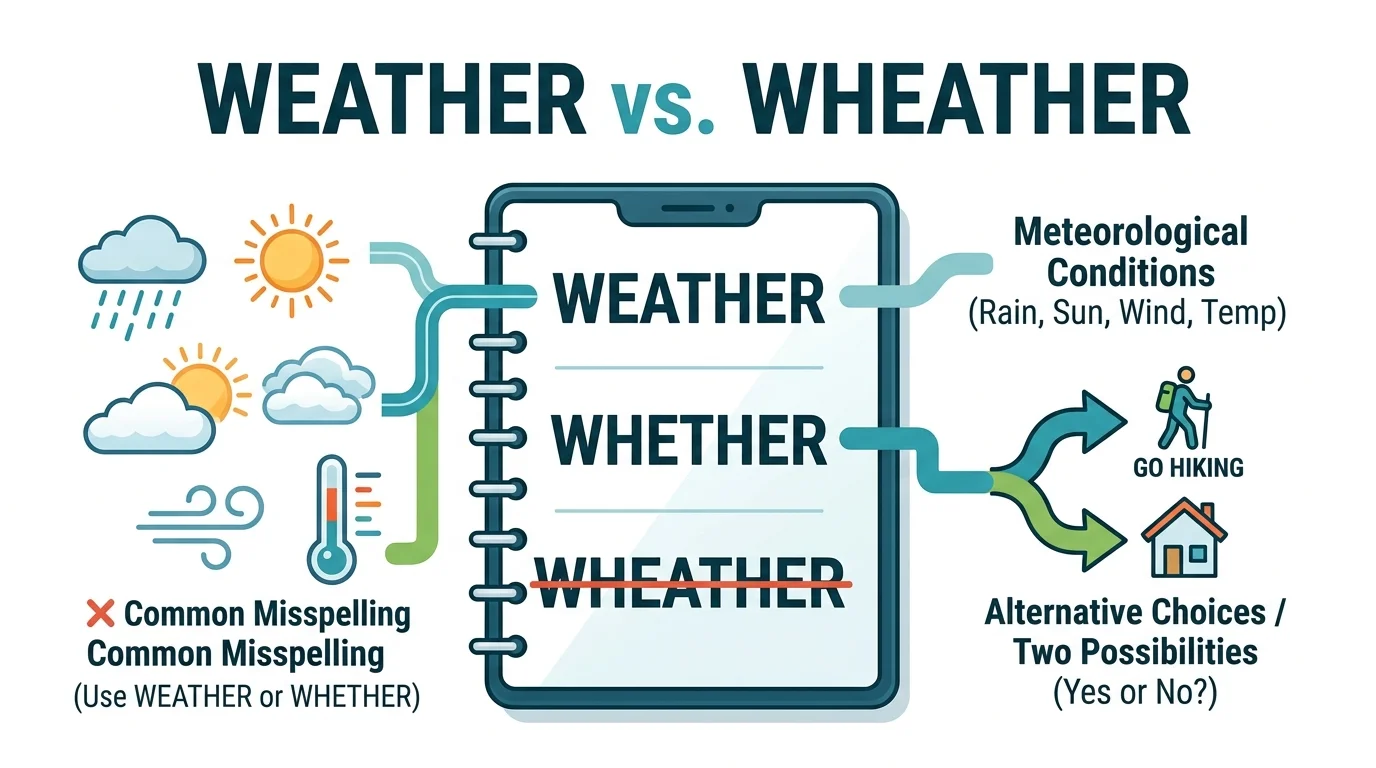

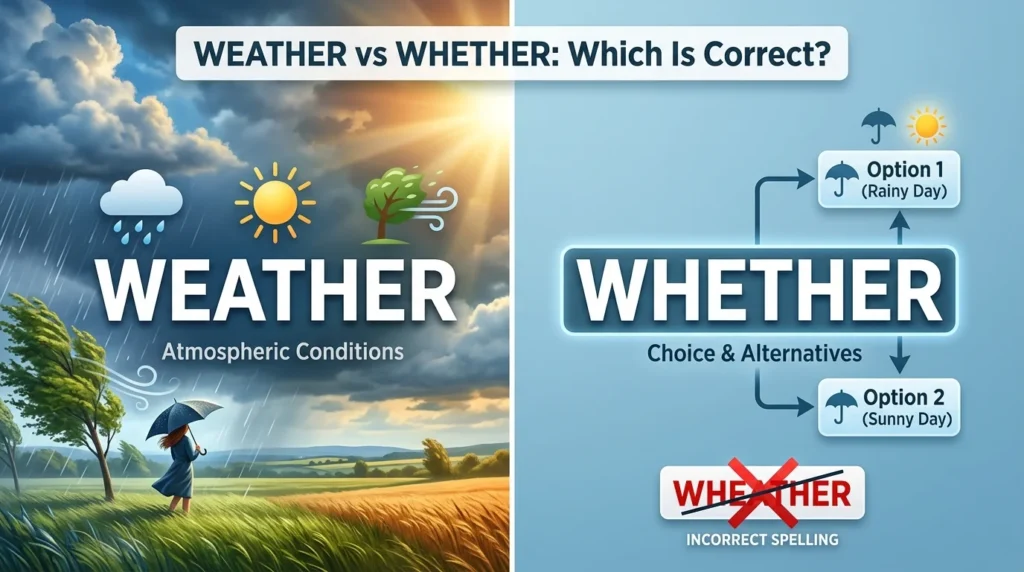
Have you ever typed “wheather” and wondered whether it is actually a word? You are not alone. The confusion becomes even bigger because weather, whether, and the misspelling wheather look and sound so similar. A single extra letter can completely change whether your sentence is correct. If you are searching for weather vs wheather, the first thing to know is that weather is the standard English word for conditions such as rain, sunshine, wind, and temperature, while wheather is generally not a standard English spelling. In many cases, people who type “wheather” actually mean whether, a word used when talking about choices, possibilities, or uncertainty. This guide explains the difference in simple English, gives practical examples, covers common mistakes, and shows you an easy trick for remembering which word to use.
Meaning & Definition
Weather is a real English word that usually refers to the condition of the atmosphere at a particular time and place. It includes things such as rain, wind, sunshine, snow, temperature, and storms. Cambridge Dictionary defines weather as the conditions in the air above the Earth, including wind, rain, and temperature. (Cambridge Dictionary)
Wheather, on the other hand, is generally a spelling mistake rather than a standard everyday English word. If you see “wheather” in a sentence, the writer probably intended to write weather or whether. The correct choice depends on what the sentence is trying to say.
For example, “The weather is beautiful today” talks about the atmosphere. “I don’t know whether she will come” talks about uncertainty or a choice.
What Does Weather vs Wheather Mean?
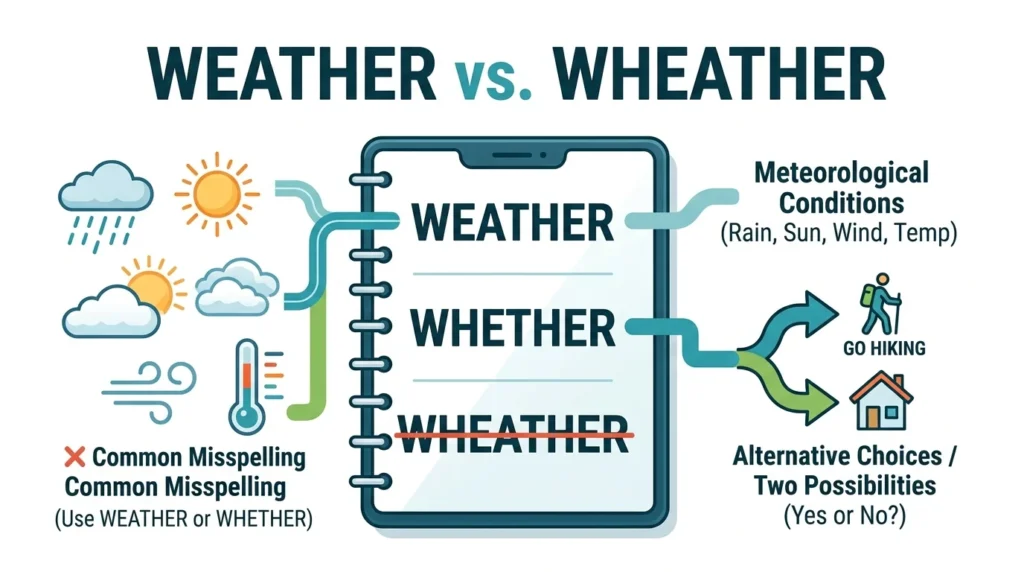
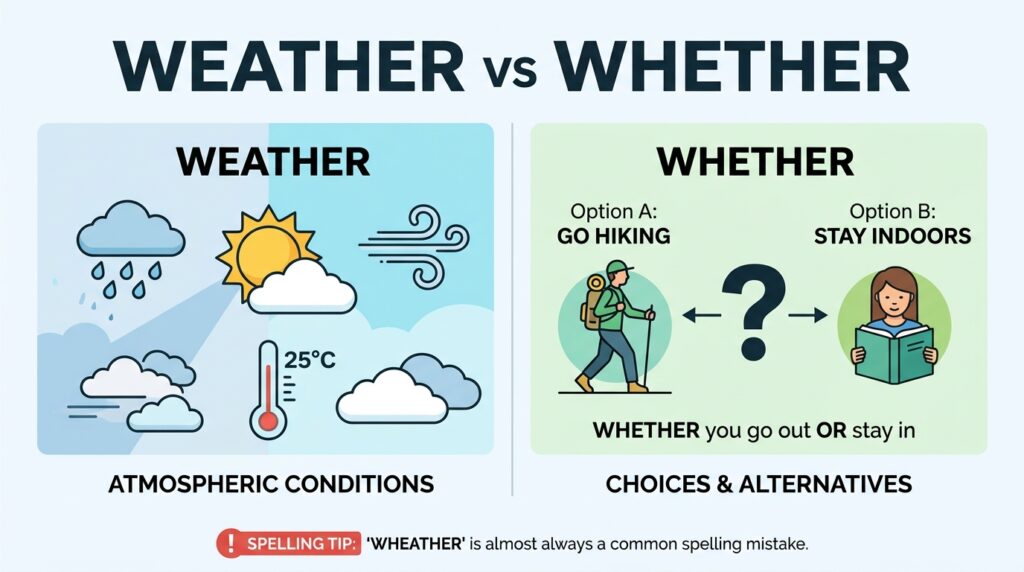
Weather is the correct spelling when you are talking about outdoor atmospheric conditions. Wheather is generally an incorrect spelling. If you meant a word that introduces a choice or expresses uncertainty, the correct spelling is usually whether.
Quick answer:
- Weather = rain, sunshine, wind, temperature, storms, or other atmospheric conditions.
- Wheather = generally a misspelling, not the standard word intended in everyday English.
- Whether = used to introduce alternatives, choices, or uncertainty.
Easy examples:
- “The weather is cold today.”
- “I don’t know whether I should go.”
- “I checked the weather before leaving.”
- “She asked whether we were ready.”
A useful way to remember this is: weather is about the outside conditions; whether is about options or uncertainty. Dictionary.com similarly distinguishes weather from whether by explaining that weather refers to atmospheric conditions, while whether introduces alternatives or possibilities. (Dictionary.com)
Background / Origin
The confusion between weather, whether, and wheather exists mainly because English spelling does not always match pronunciation. Weather and whether are pronounced very similarly, and in many accents they sound identical or nearly identical. This makes them homophones or near-homophones in everyday speech, even though their meanings and grammatical roles are different. (Dictionary.com)
The word weather has a long history in English and is connected with the idea of atmospheric conditions. Modern English uses it as a noun for conditions such as rain, wind, temperature, and sunshine. It can also function as a verb, as in “weather a storm” or “weather difficult times.” Cambridge Dictionary lists both these uses. (Cambridge Dictionary)
Whether developed as a word used to introduce alternatives or uncertainty. For example, “I don’t know whether to stay” presents a decision or uncertainty about staying. It can often be replaced by if in many sentences, although the two words are not interchangeable in every grammatical situation. (Dictionary.com)
Wheather is usually not a separate modern English word in the way weather and whether are. It commonly appears because someone has combined the spelling patterns of the two words. Fast typing, pronunciation, autocorrect mistakes, and unfamiliarity with English spelling can all contribute to this error.
Usage in Different Contexts
General Usage
In everyday English, weather is used whenever you are discussing what the atmosphere is like. You can talk about hot weather, cold weather, rainy weather, stormy weather, dry weather, or pleasant weather. For example, “The weather is perfect for a picnic” clearly refers to outdoor conditions. Weather is normally an uncountable noun, so we usually say “The weather is nice,” not “a weather is nice.” Cambridge specifically identifies weather as an uncountable noun. (Cambridge Dictionary)
Whether, however, appears when a sentence involves a choice, possibility, doubt, or uncertainty. For example, “I don’t know whether he is coming” means that the speaker is uncertain about his arrival. Similarly, “She couldn’t decide whether to buy the red dress or the blue one” presents two alternatives.
The spelling wheather should generally be corrected to one of these two words depending on the intended meaning.
Formal vs. Informal Usage
In formal writing, choosing between weather and whether is particularly important because spelling errors can affect clarity and make writing look careless. Use weather when discussing atmospheric conditions: “The event may be delayed because of severe weather.” Use whether when introducing an alternative or expressing uncertainty: “The committee will decide whether the proposal should be approved.”
In informal communication, people may make spelling mistakes such as “wheather” without noticing. A text message such as “I don’t know wheather I’ll come” is usually easy to understand because the context makes the intended word obvious. However, if you are writing an email, essay, article, application, report, or professional message, it is better to use the correct spelling.
A simple rule works in both formal and informal writing: if you mean the conditions outside, use weather; if you mean a choice or uncertainty, use whether.
Weather vs Wheather Meaning on Social Media Platforms
The meaning does not change simply because a word appears on a particular social media platform. What changes is the frequency of casual spelling mistakes and the amount of context available.
- WhatsApp → If someone writes, “The wheather is terrible today,” they almost certainly mean weather. If they write, “I don’t know wheather I’ll come,” they most likely mean whether. WhatsApp messages are informal, so people often type quickly and make spelling mistakes.
- Snapchat → On Snapchat, “wheather” may appear in a short message or caption because the sender is typing quickly. You need to look at the sentence to identify whether they intended weather or whether. The platform itself does not give “wheather” a special slang meaning.
- TikTok → In TikTok comments or captions, “wheather” is generally a spelling mistake rather than a special TikTok term. If someone writes “beautiful wheather,” they mean beautiful weather. If they write “I don’t know wheather to go,” they mean whether.
- Instagram → Instagram captions and DMs can contain either weather or whether. A sentence such as “Love this sunny weather” refers to atmospheric conditions, while “I don’t know whether I should post this” expresses uncertainty. “Wheather” is normally just an incorrect spelling.
The important point is that social media does not create a separate definition for wheather. Context determines which correct word the writer intended.
Other Meanings in Different Fields
The word weather can appear in several areas beyond everyday conversation. The misspelling “wheather” does not normally acquire a specialized meaning simply because it appears in a technical field.
- Medical → In medical communication, weather may be mentioned when discussing environmental conditions that affect comfort, symptoms, travel, or outdoor activities. For example, a report might discuss exposure to extreme heat. However, “wheather” is not the standard medical spelling. Medical writing should use the correct word according to the sentence.
- Physics → In physics and atmospheric science, weather can refer to measurable atmospheric conditions, including temperature, pressure, humidity, wind, and precipitation. Weather science involves observing and explaining short-term atmospheric changes. “Wheather” is not the correct scientific spelling.
- Technology → In technology, weather appears in apps, websites, smart devices, weather stations, APIs, and forecasting systems. A weather application may display temperature, humidity, wind speed, precipitation, and forecasts. If you see “wheather” in a software interface, it is likely a spelling error unless it is part of a specific name or user-generated content.
Examples of Weather vs Wheather in Sentences
- Example 1:
“The weather looks beautiful today, so let’s go for a walk.”
Here, weather is correct because the sentence is talking about outdoor atmospheric conditions. - Example 2:
“I don’t know whether I should take an umbrella.”
Here, whether is correct because the speaker is uncertain about a choice. The sentence is not describing the atmosphere itself. - Example 3:
“The flight was delayed because of bad weather.”
Weather is correct because rain, wind, storms, or other atmospheric conditions may affect the flight. Cambridge gives similar examples involving flights and bad weather. (Cambridge Dictionary) - Example 4:
“She asked whether the weather would improve tomorrow.”
This sentence contains both words, and each has a different job. “Whether” introduces uncertainty, while “weather” refers to atmospheric conditions.
Common Misconceptions
- Misconception 1: “Wheather” is another spelling of weather.
In ordinary modern English, this is generally incorrect. The standard spelling for atmospheric conditions is weather. If you are talking about a choice or uncertainty, the word you probably want is whether. - Misconception 2: Weather and whether mean the same thing because they sound alike.
They do not. Their pronunciation can be identical or very similar, but their meanings and grammatical functions are different. Weather is commonly a noun describing atmospheric conditions, while whether is a conjunction used to introduce alternatives or uncertainty. (Dictionary.com) - Misconception 3: Whether is always about two choices.
Whether often introduces alternatives, but it can also express uncertainty where only one possibility is explicitly mentioned. For example, “I don’t know whether he will come” expresses uncertainty even though a second option is not directly written.
Similar Terms & Alternatives
- Weather — The conditions of the atmosphere, such as rain, wind, sunshine, snow, and temperature.
- Whether — A conjunction used to introduce alternatives, possibilities, or uncertainty.
- Wheather — Generally a misspelling of either “weather” or “whether.”
- Climate — The usual or long-term pattern of weather in a particular region.
- Forecast — A prediction or report about future weather conditions.
- Atmosphere — The layer of gases surrounding Earth; in weather discussions, atmospheric conditions are often being described.
- If — A word that can sometimes replace “whether” when expressing uncertainty or a condition.
- Wether — A different English word referring to a castrated male sheep; it is not another spelling of weather. (Lawless English)
How to Respond to Weather vs Wheather When Someone Uses It
If someone writes “wheather” in a text or social media message, there is usually no need to make the conversation awkward by immediately correcting them. First understand what they mean. If the sentence is clear, you can simply respond to the actual message. If you are helping someone improve their English, you can gently point out the correct spelling.
- Response 1: “I think you mean weather here.” — Use this when the person is talking about rain, temperature, sunshine, or other outdoor conditions.
- Response 2: “If you mean a choice, the correct spelling is whether.” — This is useful when the sentence expresses uncertainty.
- Response 3: “Both sound similar, but weather is about conditions outside, while whether is about a choice or possibility.” — This is a friendly explanation when someone is learning English.
The goal should be clarity rather than embarrassment. Spelling mistakes are common, especially in fast online conversations.
Difference Between Weather and Similar Terms
| Word | Meaning | Example |
|---|---|---|
| Weather | Atmospheric conditions | “The weather is sunny.” |
| Whether | Choice or uncertainty | “I don’t know whether to go.” |
| Wheather | Generally a misspelling | “Wheather” should usually be corrected. |
| Climate | Long-term weather pattern | “The climate is generally dry.” |
| Forecast | Prediction about future weather | “The forecast says it will rain.” |
| Wether | Castrated male sheep | “The farmer raised a wether.” |
The easiest distinction is meaning plus grammar. Weather normally names something you can experience outside: rain, wind, heat, cold, or sunshine. Whether connects an idea to uncertainty or alternatives. Wheather normally belongs in neither category because it is usually an accidental spelling.
Another useful comparison is weather vs. climate. Weather can change from hour to hour or day to day, while climate describes longer-term patterns. Similarly, a forecast is not the weather itself; it is information or a prediction about weather.
Remembering these differences will help you avoid several common English mistakes at once.
Relevance in Online Conversations & Dating Apps
The difference between weather, whether, and wheather matters in online communication because people often type quickly and rely heavily on sound rather than spelling. On WhatsApp, Instagram, Snapchat, dating apps, and other messaging services, a person might type “I don’t know wheather I should go” without realizing that whether is the correct spelling. The meaning is usually obvious from the sentence, but the mistake can still affect how polished the message appears.
In dating conversations, both correct words can appear naturally. Someone might ask, “How’s the weather there?” when making conversation or planning an outdoor date. Another person might write, “I don’t know whether I can make it tonight,” which expresses uncertainty. If someone types “wheather,” the surrounding sentence normally tells you which word they intended.
This is especially useful for people communicating with English learners. Instead of assuming “wheather” has a hidden slang meaning, check whether the sentence refers to outdoor conditions or a choice. If it is about the sky, use weather. If it is about uncertainty or alternatives, use whether.
In short, online communication may make the spelling error more common, but it does not change the meanings of the correct words.
Weather vs Wheather From a Girl
If a girl sends “wheather” in a message, the spelling itself does not have a special meaning because it comes from a girl. The correct interpretation depends entirely on the sentence.
For example:
“The wheather is so nice today!”
She most likely means:
“The weather is so nice today!”
Here, she is talking about outdoor conditions.
But consider:
“I don’t know wheather I should come.”
The intended word is probably:
“I don’t know whether I should come.”
In this case, the sentence expresses uncertainty.
There is no reliable grammar rule in which “wheather” means something different when a girl uses it. Online messages are often typed quickly, and spelling mistakes happen to everyone. Therefore, it is better to interpret the sentence based on its meaning rather than the sender’s gender.
If you want to correct the mistake politely, you can say, “Just a quick correction: it’s weather in the first sentence,” or “Here, you probably mean whether.” This keeps the conversation helpful without making a small typo seem more important than it is.
Weather vs Wheather From a Guy
If a guy types “wheather,” the same rule applies. The spelling does not have a separate meaning because the sender is a guy. Look at the sentence to determine whether he intended weather or whether.
For example:
“What’s the wheather like there?”
The intended sentence is:
“What’s the weather like there?”
He is asking about atmospheric conditions.
Now consider:
“I don’t know wheather to stay or leave.”
The intended sentence is:
“I don’t know whether to stay or leave.”
He is describing a choice.
This distinction is especially useful in texting because short messages sometimes make people search for hidden meanings that are not actually there. If someone writes “wheather,” it is normally much more reasonable to treat it as a spelling mistake and use the context to determine what they meant.
Whether the sender is a guy, girl, friend, coworker, or stranger does not change the standard English definitions. Weather means atmospheric conditions, whether introduces uncertainty or alternatives, and wheather is generally an incorrect spelling.
Frequently Asked Questions
1. Is “wheather” a correct word?
Generally, no. “Wheather” is usually a misspelling of weather or whether. The correct word depends on what you want to say.
2. What is the difference between weather and whether?
Weather refers to atmospheric conditions such as rain, wind, heat, and sunshine. Whether introduces a choice, alternative, or uncertainty. (Cambridge Dictionary)
3. Is it “weather or not” or “whether or not”?
The standard expression is “whether or not.” It refers to whether something happens or does not happen. For example: “I will go whether or not it rains.” (Proofed)
4. How can I remember weather vs whether?
Use this simple trick: weather = what is happening outside; whether = which possibility or choice. If you can replace the word with “if” and the sentence still makes sense, whether may be the correct choice.
5. Is “wheather” a word on social media?
Usually, no. When “wheather” appears in a social media post or message, it is generally a spelling mistake. Read the surrounding sentence to determine whether the person meant weather or whether.
Conclusion
The weather vs wheather confusion is easy to solve once you understand what each spelling is supposed to represent. Weather is the correct word when you are talking about atmospheric conditions such as rain, wind, sunshine, snow, temperature, or storms. Whether is the correct word when you are expressing uncertainty, presenting alternatives, or discussing a choice. Wheather is generally a misspelling rather than a separate everyday English word.
The simplest memory trick is to ask yourself what your sentence is about. If you can look outside and experience it, you probably need weather: “The weather is cold today.” If your sentence involves a decision or uncertainty, you probably need whether: “I don’t know whether I should go.” These words may sound the same or nearly the same, but their meanings and grammatical roles are different. (Dictionary.com)
Once you learn this small distinction, you can avoid one of the most common spelling mistakes in everyday English, whether you are writing an essay, sending a message, posting on social media, or communicating professionally.